I’ve been championing work for our design org around what I’m calling “Foundations”. These are the pillars where if any one of them were to be unsteady, it would affect everything else. They are represented by the following:
Principles
Purpose
Values
Mission
Vision
The problem with doing these after an org has been well established (which it was before I got here) is that going back to do what should have been done from the beginning creates confusion on how to approach each of these. If nothing else, because it’s kinda like retconning. Also, many of these crossover with others and thus they can sometimes be hard to distinguish from each other.
I’m currently running a workshop with my design leadership team (this is after I led one with the whole org where each and every person got to provide their versions of these and we in leadership are using their inputs as the basis for our work) and we were having a hard time grokking the difference between some of the concepts. On paper the differences make some sense, but when you get to writing them you start to see how they all blend together and that is where things get confusing.
While enjoying a rewatch of one of my favorite series before it was taken off of Netflix, I had an epiphany. So, I got really nerdy and I came up with even more examples but all from a single source (versus the myriad of ones I had collected from multiple companies).
Thought some of my readers might enjoy this:
Star Trek: The Next Generation Mission Statement “Space: the final frontier. These are the voyages of the starship Enterprise. Its continuing mission: to explore strange new worlds. To seek out new life and new civilizations. To boldly go where no one has gone before!”
Series Principles “Roddenberry detailed five items in the handbook that must be followed to create a “Star Trek” story. Those were: the stories were about people; framed in an optimistic vision of the future; from the point of view of captain and crew; and the regular cast are each episode’s heroes, and the home base of the crew is the Enterprise.”
Value One – Inclusivity and Diversity “The Enterprise crew should be ‘completely multi-racial.'”
“Diversity contains as many treasures as those waiting for us on other worlds. We will find it impossible to fear diversity and to enter the future at the same time." -Gene Roddenberry
Value Two – Optimism “Leonard Nimoy often said that what set Roddenberry’s creation apart from the other science fiction franchises was optimism.”
Value Three – Hope “‘A lot of science-fiction is nihilistic and dark and dreadful about the future, and ‘Star Trek’ is the opposite,’ Nimoy told the New York Times in 2009. ‘We need that kind of hope; we need that kind of confidence in the future. I think that’s what ‘Star Trek’ offers.'”
Vision “Star Trek shows us that no matter how bad the world outside our windows gets, there is still a bright light at the end and that humanity has the potential to be so much more than it has ever been.” – Andrew Hales
I didn’t come up with all of these examples myself, you can find the source for most of the quotes (save for the mission statement), here. Rather, what I’m doing here is taking a unique approach to this problem space and applying the provided examples to help us understand some seemingly simple yet somewhat complex concepts we (should) find in the business world.
Well, it’s been a hot minute since I posted here. I just received notice a week or so ago that my server was being moved to a new one at my webhost (where I’ve hosted my sites for OVER TWENTY YEARS – how the hell is that possible?). So, I thought I’d come check out the site and well there are some bugs here and there. I’ve tried to clean up as much as I could, but it’s 3am on a Monday morning (hey, it’s a holiday if that matters), and I’m over it at this point. So if you find some weird characters where punctuation should be, just know it’s due to the fact that it wasn’t encoded in the database correctly when it was originally posted and well there are nearly 15 years of posts here at this point, which means going back to fix them all will take some time.
I do have to say though it was a bit of a trip going back to April of 2007 for this blog’s first entry (though the first official one was September of 2007, it went back to April because I’d brought over some LJ posts I’d made to a corresponding community I’d started there prior to starting this blog). So yeah, I’ve tried to catch as much as I could, but I’m sure I’ve missed some and others I’m too tired to deal with at this point (I know for a fact my undergrad work under the academic nav point needs to be fixed, but that’s more than I’m willing to take on right now).
So, where have I been?
Alas, I’ve been absent here since about July of 2020 due to starting a new job (as an Associate Director of Design at Blizzard – holy crap, I actually work there) a couple of months after my last post. Then, over the next year, we had 3 deaths in our family and moved across the state for said job. Combine all of that with the fact that I’m also homeschooling my 3 kids and now taking care of my soon to be 98 year old grandfather with Alzheimer’s (my grandmother passed in August of last year due to catching COVID at the hospital, which makes me his caretaker now), and well – time has been a bit scarce.
Still Gaming
Don’t worry, I’m still raiding (mythic 7/10 this tier [SoD – ends tomorrow] horde side though I still kept my beloved NELF and just leveled up my Troll so I could mythic raid with friends) on top of all of that. I’ve stuck with playing WoW as it’s my pixel therapy that I hold in high priority as it’s the one thing my husband and I really enjoy doing together and it allows us to socialize with people out there in the real world without having to be actually out there in the real world. I also play FFXIV now as a Red Mage (have since May of 2020 – I have a few other jobs as well, like you do) and I’ve picked up Lost Ark as a Bard (came out in the U.S. last week), because why not.
Say Hi
Not sure anyone reads this much anymore, but if you do – feel free to leave a comment and say hi or use the Contact page to shoot me a message. I may try to post more often if there are still readers out there. 🙂
Update: I’ve edited a few parts to make it a little clearer. Same message, just easier to understand. Iteration for the win!
This could have also been titled: “Why you are doing your organization a disservice if you’re hiring researchers to only conduct usability testing, or hiring designers to do research.”
Welcome to this week’s soapbox post!
If you’re familiar with me or my work or you’ve been keeping up with this blog, you know that I am currently in the market for a new job. I fully realize in a post-COVID world that being a researcher (while it should be one of the most important roles today for a lot of companies during turbulent times) is actually a very tough position to be in when looking for a job as it’s always one of the first cut in product development.
I think this happens for several reason, two of which I am going to address today.
One: A lot of job descriptions I’ve read lately are looking for UX people who are capable of conducting research and doing usability testing. While these are indeed admirable traits to have as a UXer, and I’m one of those UXers that embodies them, I would not recommend relying on your designers to do all of the research work that should be done. Why? Well, if for no other reason these are two different skillsets. Additionally, if you have an agile environment with a continuous release cycle, your designers are already too busy keeping up with that. Not to mention the fact a proper research team should be a full quarter or two ahead of them! It is difficult to encompass both of these capabilities in the same role. Research should be a full quarter or more ahead, you ask? Yes, and this brings me to my second reason.
Two: There is a lack of understanding of what research is and how it can be useful. Usability testing (and yes it’s usability testing NOT user testing – we are testing the usability of a site not the user’s ability to use it, those are two different things and this means a lot when you get into inclusive design) is not the end all be all of user research. In fact, it is a tiny sliver and if the appropriate research has been done ahead of time in your organization, you will not need it as often and you won’t have to rely on it as much.
So let’s break that last point down. Usability testing is generally what I see organizations who are new to research using to dip their toes into the discipline. They have read and seen why it is important and think that it will make a difference for their users. This is all correct. The problem is many organizations who are new to this think that’s all there is to research and they feel they have to test every single thing before it is released. In reality, research should be more about problem finding than trying at the very end to work on testing solutions to problems that were likely not fully understood to begin with.
If you have a research team that is versed in problem finding (utilizing generative/exploratory/discovery methods) and uses those skills to help your product people fill their gaps and blind spots, it is likely that a lot of the issues that your products or services are currently challenged with will be solved as a nice side effect when you focus on those uncovered during this phase. Why? Because, solutionizing right out of the box is how a lot of products and services find themselves in trouble. Going problem finding opens your organization up to a whole host of new possibilities and opportunities that would be otherwise missed and cause issues down the road because you didn’t know they existed.
By conducting exploratory and discovery sessions first, you’re connecting with the people in your space who are trying to solve their problems with your product or service. When you understand what those are, it makes it easy to see that they are the problems your work should be focused on. If your product or service does not solve problems for your users, it doesn’t matter how usable it is or how many features it has, it will never end up being what they are looking for.
Additionally, the treasure trove of data your researchers will come back with during this phase will likely reveal a lot more opportunities for ideation and innovation than any single product manager will have the capacity to do. (This also helps relieve some of the pressure product managers have due to all of the other responsibilities they are saddled with in this day and age.) The added bonus is that when you use data to drive your designs from the beginning, it results in designs that have fewer hurdles to cross when it comes to usability testing because they started with a firm foundation of data to support them.
In the end, this results in faster design, development, and testing time which equals faster time to market. This, however, ONLY works if you have a research team that is able to work well ahead of your design and development teams while at the same time also working through the design and development phases to continue advocating for the users throughout the entire product life cycle. This is why I do not recommend designers be the ones who also have to shoulder that responsibility. Yes, EVERYONE on the team should be a part of the research process, but they also have their own roles to play and the researcher is there to help make it easier, faster, and more efficient for them to do so.
So the next time you’re writing a job description, I beg of you to keep all of this in mind. And, when you’re looking to cut – consider the amount of money a researcher can save you and make you if you truly utilize them in the right ways.
The first I heard of COVID-19 was at the end of January. I had a team member visiting family in China. She had flown out the morning the news broke here so she was in the air when we all found out what was going on. I was worried for her safety and her safe return. None of us had any idea that the effects of it would become so much broader than the concern we had at the time for our single team member. Within 2 months everything was locked down to help slow the spread. For a research team at a hospitality company, that meant our work took a hit as well. Three months later, we find ourselves here.
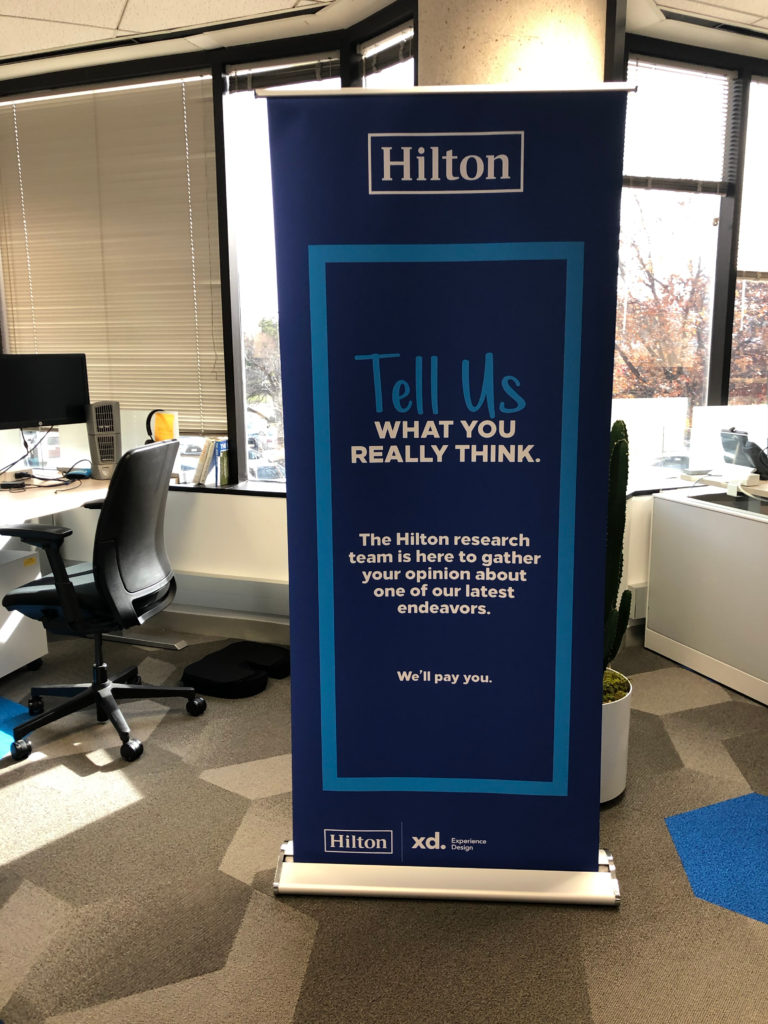
Tell us what you really think!
Last week was a hard week for my team at Hilton. We had hope we’d make it through, but in the end it was all for naught. I have to say, I really liked my job. I loved leading a team of amazing and brilliant researchers consisting of PhDs and Masters. They made it easy. They knew what they were doing and were able to carry out their work with no need for micromanagement (that’s not my style anyway). When problems or questions came up, they were interesting and challenging and we worked together to solve them.
At first I didn’t understand why they wanted a director with 14+ years of research experience yet was tasked with no hands-on research (even as the head of a research team at IBM, I still did a lot of heavy lifting). It was only after I started fielding actual on the job issues that it became much clearer. Though this was a different experience than the one I had at IBM where I had to build a team from scratch and then teach each of them what it meant to do research in the corporate world (much through example), I still found it worthwhile and fulfilling.
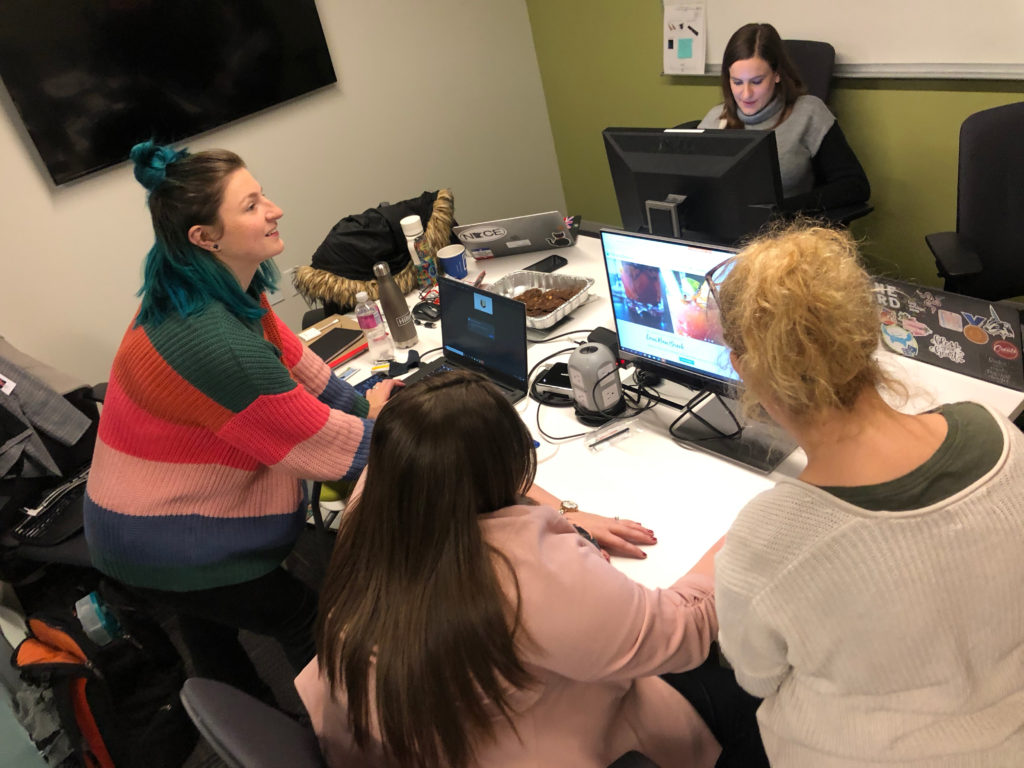
Setting up eye-tracking
What was great about this team was that no one was afraid of what they had to do even if it was something completely new to them. Though we rarely worked together on the same project (they were all embedded on separate teams), when someone needed help, everyone jumped in!
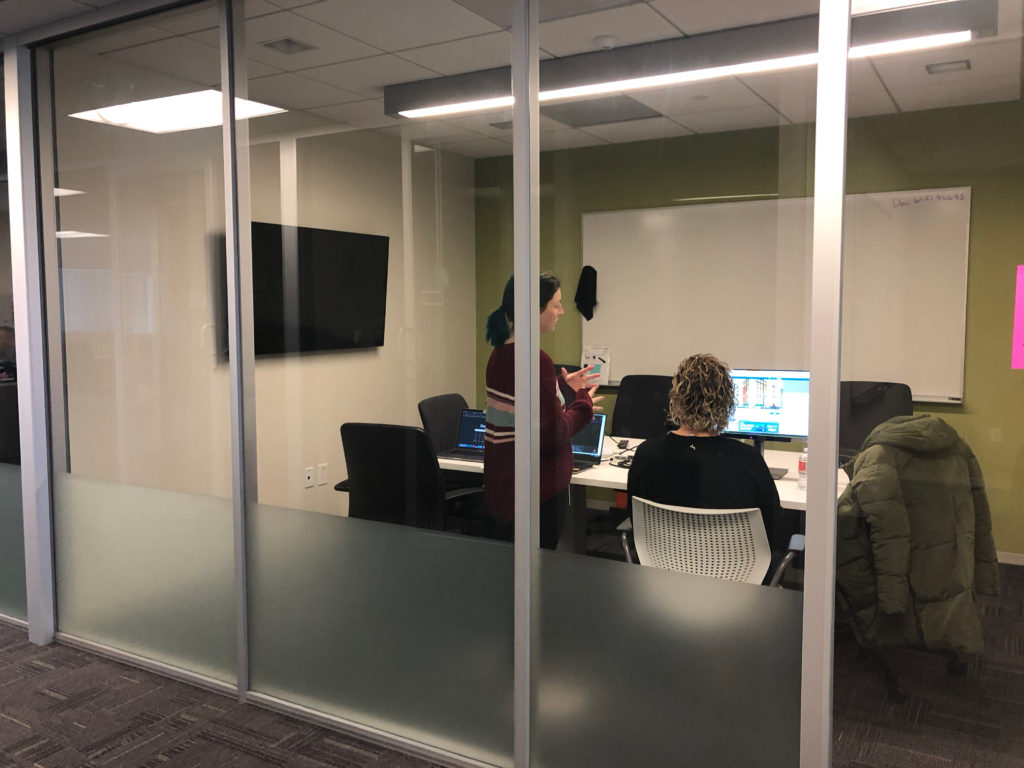
For example, it is practically impossible to run an eye-tracking study alone. We spent an entire day together working out the research plan and then getting the hardware and software setup and running. It was a true team effort from researchers working on the ins and outs, to me setting up (and scavenging) the hardware and observation setup, to our research ops manager getting the eye-tracking company on the phone to help us get the software working. There was a real camaraderie where everyone was there for each other. We all wanted it to be successful and we knew we had to work together to make that happen.
The best part about my job was I felt like I really made a difference. I mean, what more can you ask for when you walk into an existing team. I focused on building up the team culture as well as the practice of research and the strengths of each individual. We worked hard to show the value we could bring and why research was important.
Conducting eye-tracking
We had regular 1:1s where we discussed whatever they needed to that week. We had regular team meetings where we shared knowledge and expertise and learned from each other at all levels. And, we had a bookclub where we learned with each other. We genuinely cared about each other and our work, our users, and the company.
We haven’t worked together for nearly 3 months, but we all still chat in my personal Slack where I field everything from mentoring questions to keeping up with our ongoing bookclub and now help finding jobs. We may not work together anymore, but we are still a team.
Our last bookclub read
What is sad is we had only been together 5 months. We were just getting started. I had a lot of great plans for the team. We were working on building up our own research repository that met our needs and would eventually fulfill the self-service needs of those with whom we worked. My next goal was to get our own Jira board and workflow setup so that we could standardize the way we took in research requests and so that it would be easy for me and my ops partner to show data to support the work our team was doing and that we had more work than people! (This worked well for me using Git at IBM, I was really excited about getting it going at Hilton, too.)
Additionally, I was making an effort on maturing the research model within the company. This meant gradually moving it from one where design relied heavily upon a lot of usability testing to one who tested when needed, but also prioritized problem finding – looking deeper into the wants and needs of our users from our guests to our hotel staffs – so we could solve the problems that really mattered instead of just focusing on things one screen at a time. I was also working out how to create a more inclusive research and usability testing process reaching out to our recruiters and panel companies on how to do this with dignity and purpose.
At the team level, I pushed for them to be thought leaders and to find ways to share their knowledge and craft with the outside world. One of our goals was to have Hilton Research representation at as many conferences as possible. The last panel we submitted was on how brick-and-mortar businesses could go through their own digital transformations and come out the other side with some very innovative products and services (digital key and connected room were my two favorite future facing technologies we worked on).
We could have done so much. I’m so thankful for having had the opportunity to have been a part of it all. It’s rare that I’m at a job less than a year (though my last one was a year and a half, the one before that was nearly 9 years). While this one was short, it will always have a place in my heart.
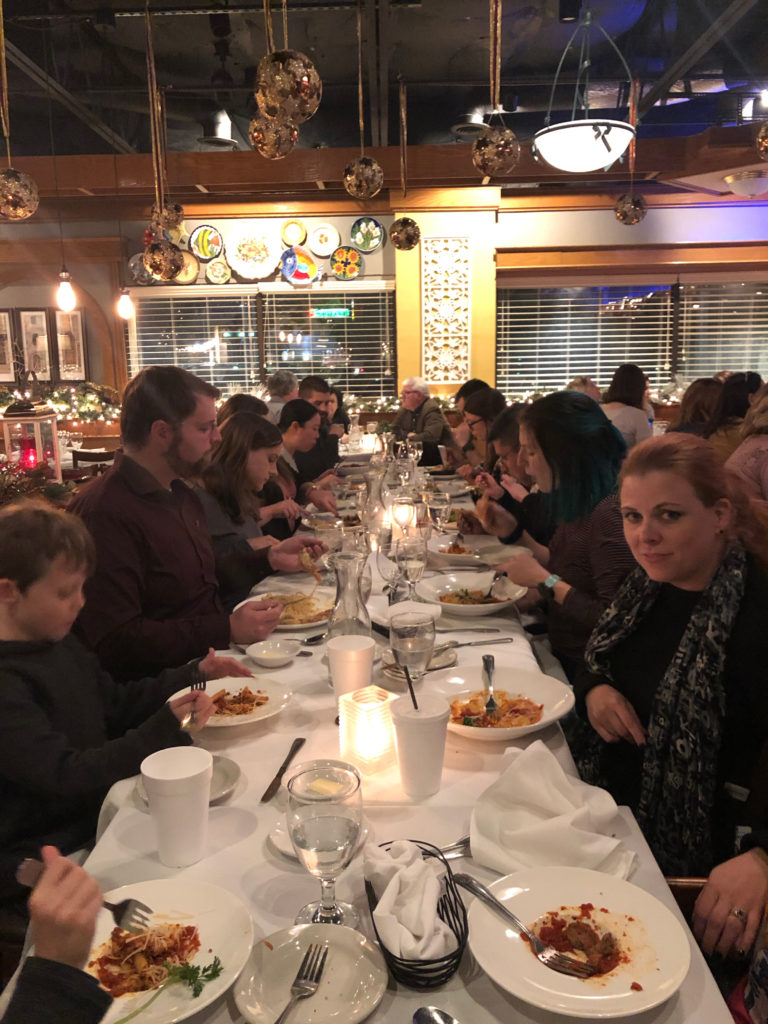
Holiday team dinner
I know this socio-economic crisis has had a real human toll across the entire world. And for us, though we no longer have jobs, we are all physically safe and healthy. And for that, I am thankful. However, I know we all have families to support and that is very hard to do without an income. So, I am going to end this post with LinkedIn profiles of a few I know still looking for work including my own. Please feel free to forward these on to anyone needing top research talent and/or research & design leadership experience. Hilton only hired the best, so please let their loss be your gain.
I recently found out my contact form was not working properly. As I’m not sure how long it has been down, I have to say if you’ve tried to contact me over the last 6 months or so (maybe even longer!), it may not have worked. However, I have fixed it! And, now you can contact me without issue. I also have a backup solution that will catch anything should it break again.
On the 4th anniversary of the release of my dissertation, and since I haven’t had time to publish to any journals like most academics do (read: 3 kids plus a full time job leaves little time for little else), I’ve made use of my furlough time to do a quick (well academically quick) writeup of the model I developed as a part of my research on parental assessment of video game appropriateness for their children. Some may find it interesting or wish to challenge it or both. I figure anything is better than letting it stagnate in a 200 page dissertation no one is going to read.
Below you will find the simplified model, an explanation of its basic parts, as well as the more developed version below it. For a full explanation with examples from my study, it starts on page 169 of my dissertation. If this has piqued your interest, I have also created a quick writeup of my study (to save you from reading the entire dissertation) and I have published the slides I used in my dissertation defense.
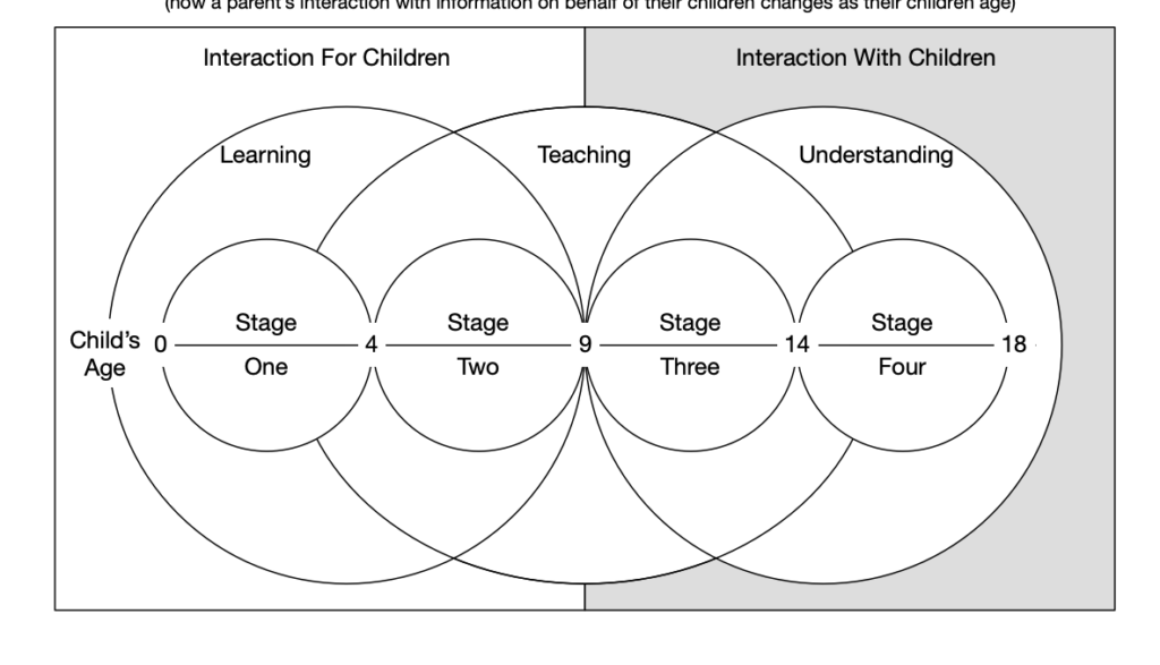
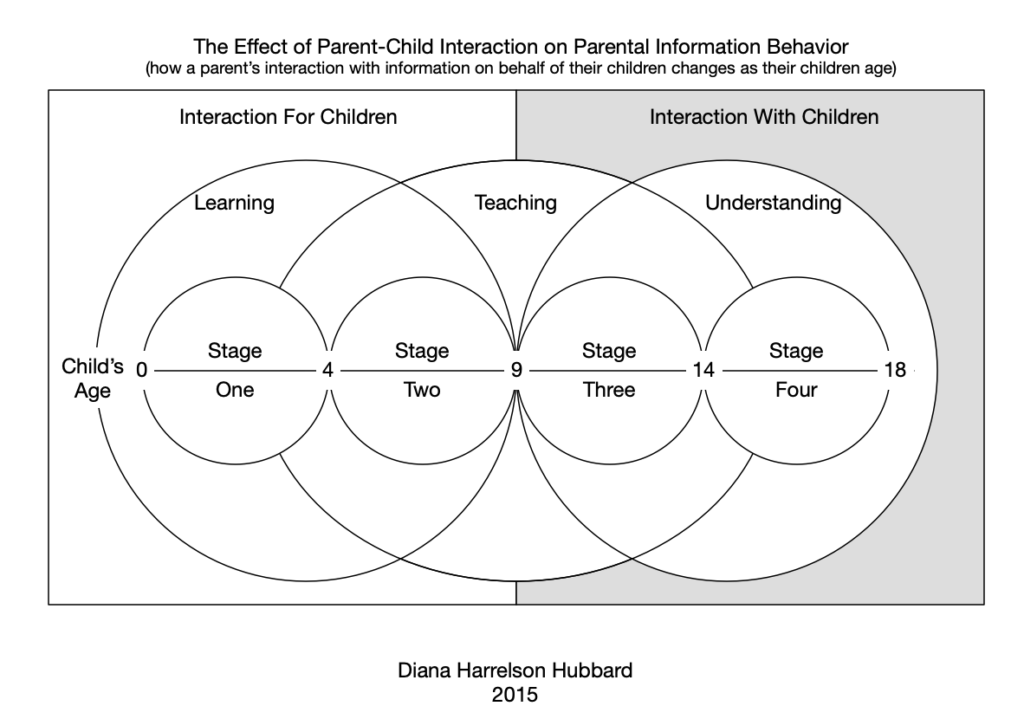
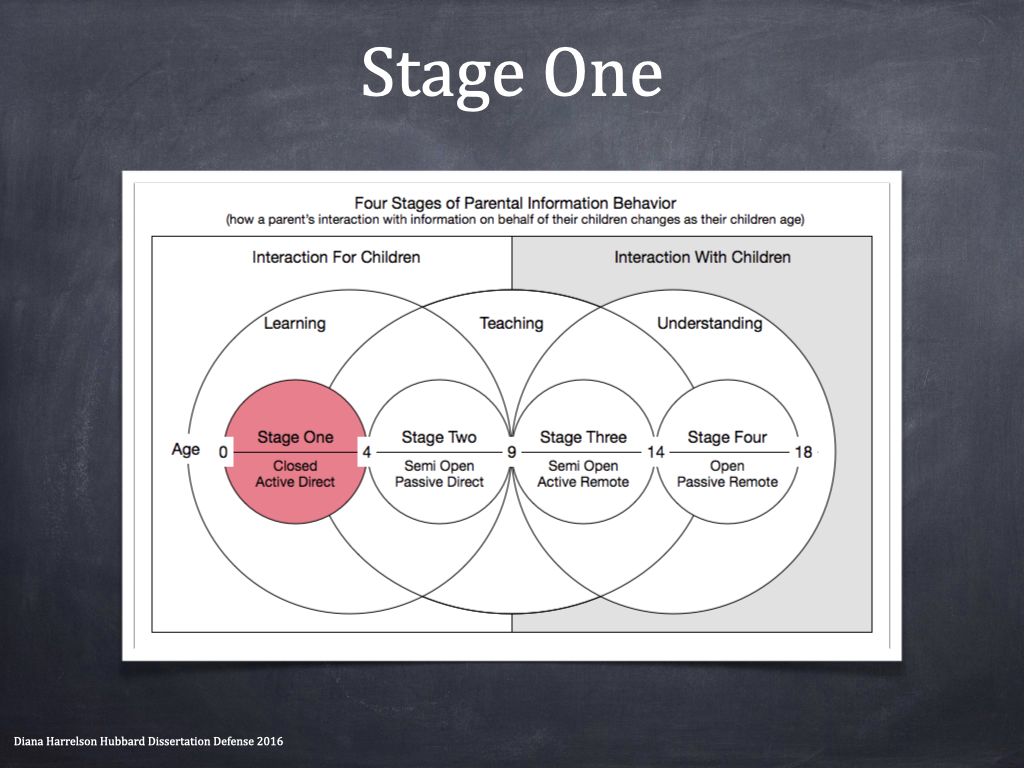
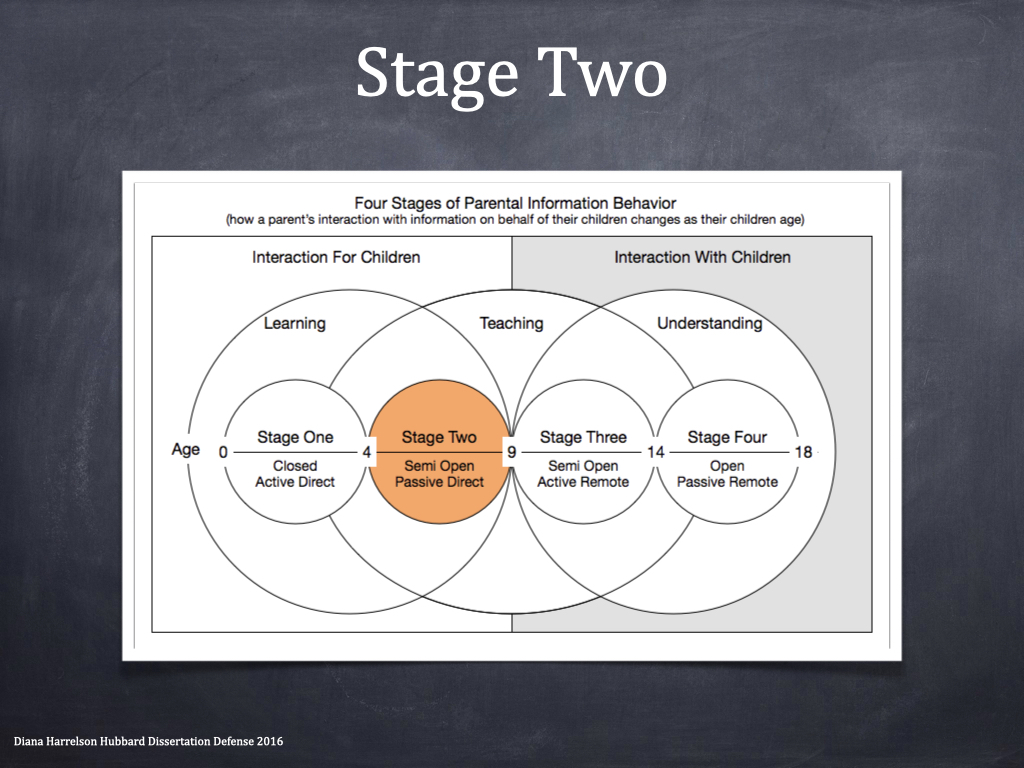
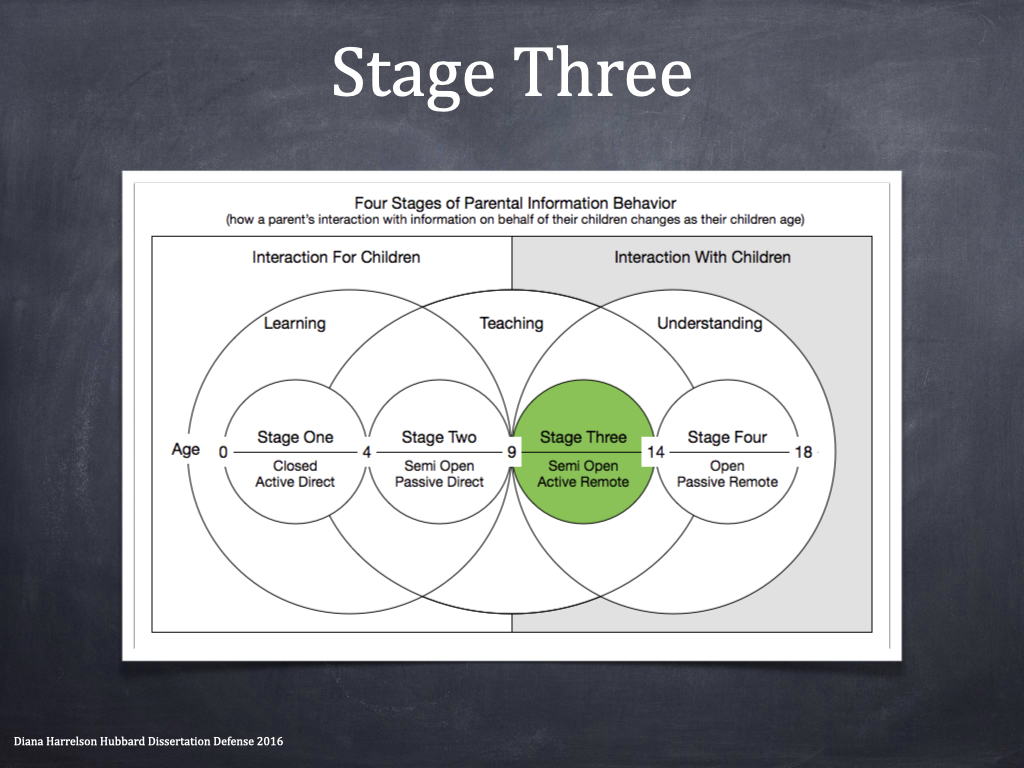
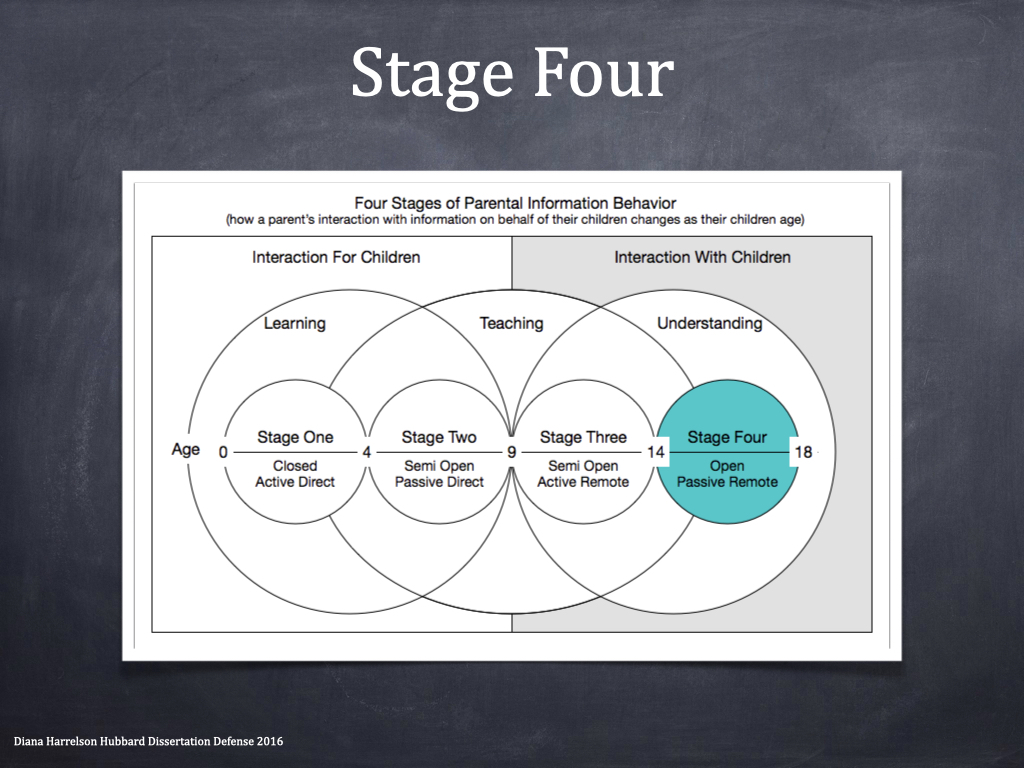
The effect of Parent-Child Interaction on Parental Information Behavior: A Model by Diana Harrelson Hubbard (2015)
This is simplified from my original version (see below), but I think that makes it easier to utilize for other studies and other types of parental information behavior above and beyond video game assessments.
Breakdown:
The model consists of 4 basic parts.
The first is the dividing line that separates Interaction For Children and Interaction With Children.
The second are the intersecting domains of Learning, Teaching, and Understanding
The third is the age timeline from 0 to 18
The last are the stages from 1 to 4
Part 1: Concept – the interactions of parental information behavior and their children change as their children age.
Moving from interacting FOR children to interacting WITH children. This defining line made itself evident after evaluating how parents of children of different age groups interacted with information when it concerned their children and how *successful that interaction was depending on the type and domain of interaction and the child’s age.
It became evident after evaluating the data that parents who had more conversations with their older children and who made decisions with them had more success in having open and clear communication about media and its appropriateness than those who decided everything for their children and subjected them to a more authoritarian rule. Those parents who worked with their older children were less worried about their children’s interactions with media than those who preferred to do things for them.
*success is of course subjective here but usually included the lack of a need for discipline or worry because the parent/child relationship was such that there was a clear level of trust or at least an evolving one that they were working on together
Part 2: Concept – the parental information behavior domains parents interact within as it concerns their children changes as their children age.
The learning domain consists of all of those things parents do to learn what they need in order to parent. This includes the information rush parents go through when they find out they’re expecting as well as interacting with it to fulfill their children’s information needs before their children are able to do so on their own.
The teaching domain consists of the information behavior as it relates to the parent helping to teach the child whether it be a homeschool situation or supplemental to an external student learning system. It is also about teaching the child how to interact with information on their own. This environment bridges the For children and the With children as the child ages and becomes more independent in their own information behavior.
The understanding domain is the beginning of a mutual understanding between the child and the parent as the child becomes independent in their information behavior and the parent seeks to understand their child’s new information needs and behaviors.
Part 3: Concept – tracking parental information behavior as the child ages from 0 to 18.
Though my research focused on recruiting parents of children 4 to 17, parents discussed younger and older children as well as children’s behaviors when they were younger. For example, the average age most children in the study started gaming was 3.5. This timeline is most important as it relates to part 4.
Part 4: Concept – parental information behavior, as it concerns their children, tends to go through 4 stages corresponding to the child’s age. **
Stage 1 – Birth to Age 4
Stage 2 – Age 4 to Age 9
Stage 3 – Age 9 to Age 14
Stage 4 – Age 14 to Age 18
Stage 1 Birth to Age 4 In this stage the parent’s information behavior as it concerns their children is for their child and focuses primarily on learning about parenting and then transitioning into teaching as the child hits pre-school age.
Stage 2 Age 4 to Age 9 Parental information behavior in this stage is a two pronged approach still on learning, but with an emphasis on teaching. Here, the child starts to become more independent and starts to be able to take on their own information needs, but they tend to still have a lot of needs that only their parent can fulfill. Additionally, due to their young age, they still have a lot of supervision.
Stage 3 Age 9 to Age 14 This is the stage where parents were most concerned in my study. This was for two important reasons. One, children were becoming completely independent in their own information behaviors needing less assistance from their parents. And two, this is the stage where most children start to enter puberty. Here, parents were less concerned with violence and more concerned with sexual content or other improper things like language and drug use.
Stage 4 Age 14 to 18 By the time the child enters high school, or just after, and until they are deemed an adult by culture and society there is an interesting phase where the child can in some cases surpass the parents abilities and understandings when it comes to media and information behavior as it pertains to popular culture and even technical aspects. If a parent has not fully transitioned from For to With and has not moved into wanting to understand what their teen is doing and why, from the teen’s perspective, they will likely lose all control, access to, and input on the teen’s media consumption. This is especially the case the more authoritarian they become and this will cause the teen to hide their information behavior instead of share it (or at least a portion of it) with their parents.
**Side note: There may be differences as to how parents approach these stages with subsequent children and that may also depend on the age gap between their children. Additionally, I did NOT do any research on child information behavior specifically, nor did I focus on any previous research on children and media. My research was focused solely on parents, so this can certainly be added to over time as needed to focus on the needs of children if it makes sense to do so.
Now, if you review my presentation of my dissertation defense, you will see a more detailed version of this model, which I will add below.
Added details: Any information behavior activities the child has at this stage are actively and directly observed by parent and tend to be on a closed system (no outside access).
Added detail: At this stage, parents tend to provide their children their own devices, but in a locked down mode, which allows for semi open interactions that can be supervised as needed (passive) but in the presence of their parents (direct). Online access usually comes in the form of white listed programs or school related needs.
Added Detail: During this stage children become more independent in their media use and information needs as they need less help from their parents in order to do so. While the system may still be only semi open (some lock downs still exist), the child is now able to interact with their media outside of the parents purview. This new independence tends to come with a cost though as the parent becomes more active in paying attention to what their child is doing via remote observation (nanny programs).
Added Detail: In this stage parents had the least amount of influence or control over the information with which their children interacted, thus their children made most of their information behavior decisions on their own. While parents still made decisions at this stage, children tended to have more influence on the decisions being made. Here there were natural barriers to Mature content which included initial cost and access to a credit card.
Though most teens had open access to interact with information as they pleased in that they were less restricted the older they were, their parents still had control over the access itself and would remove wireless/mobile access when needed (passive monitoring – decisions made here were usually based on grades, attitude etc.) instead of trying to control access to specific things at an application level. This meant it ended up as an all or nothing for the teen. As teens tend to be very protective of their online access, it was a line few wanted to cross.
So? What’s the point?
From my dissertation:
This model was designed to show how interconnected parent-child interactions are with parental information behavior and the effects of this interconnectedness on it. To put it simply, parental information behavior cannot exist without this interconnectedness and it is because of this interconnectedness that it needs to exist as well as persist and change over time.
The examples [see dissertation starting on p. 169] were provided to show how parent-child interactions affect parental behavior on a multitude of levels including information, communication, and decision-making strategies. Additionally, they were to show how this behavior both changes and becomes more complex as children age. Thus, a ratings system that provides the same type of information for every level at every stage may lose the ability to successfully help the parent as their child ages and they reach the later stages, which is arguably when both parents and children need it most.
The major take-away is that children can greatly affect how and why their parents interact with information and it goes well beyond age in the sense of restricting material based on age alone, especially the age ratings that are in place today. Finding ways to educate and assist both parent and child, to provide information in such a way that both can interact with it, and each other, is key to successful family information behavior and any information system that wants to support it.
This presentation was originally given at DFW Beyond 2018 (October). I was the last of the speakers on the main stage for the morning (meaning: there were a lot of people in the crowd!). I’m going to add my script here as I originally wrote it along with the screen shots from the Prezi presentation. If you want to see the original presentation as it was presented, you can find it here.
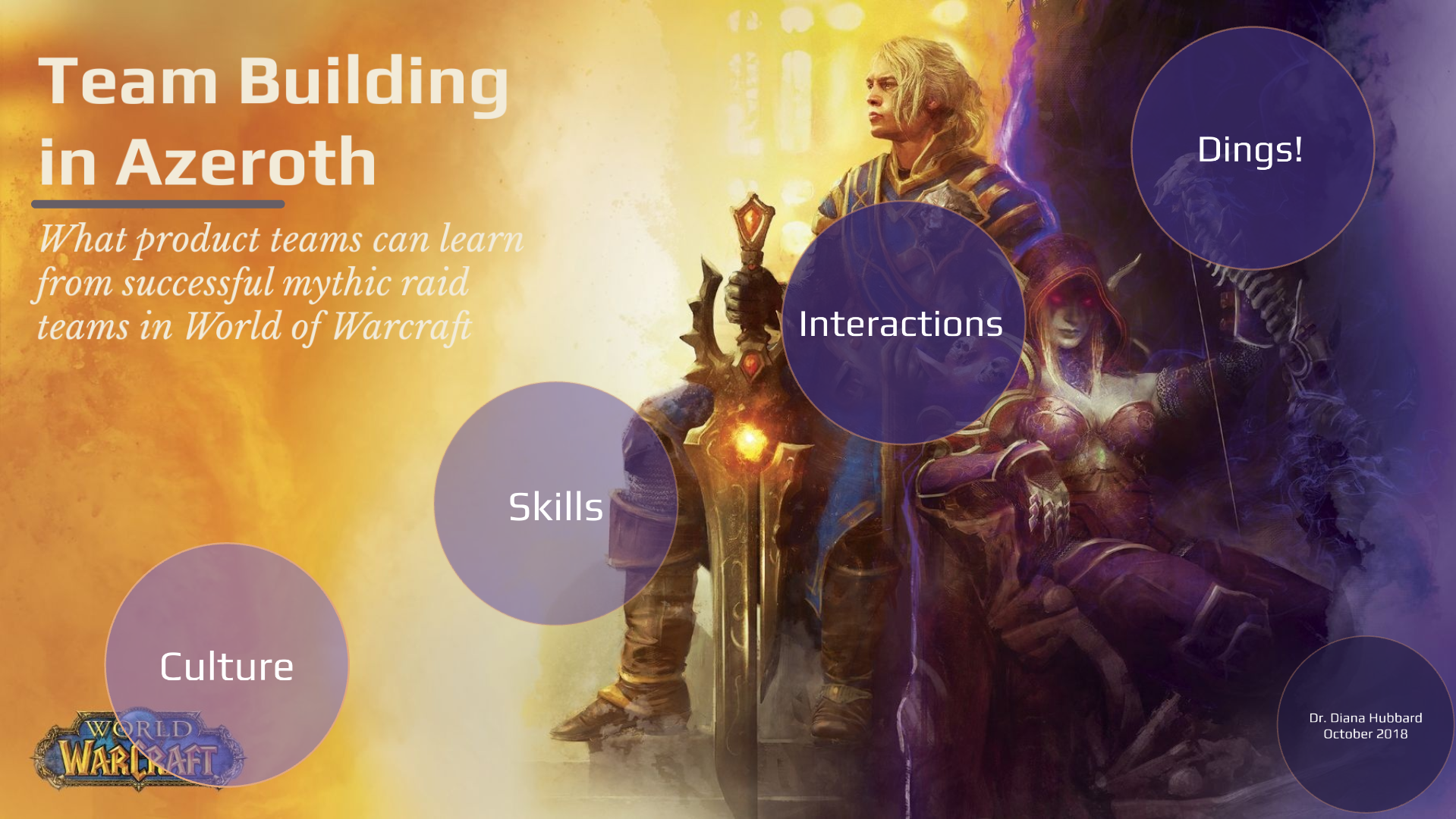
Team Building in Azeroth: What product teams can learn from successful mythic raid teams in World of Warcraft
Intro Hello everyone! We’ve heard a lot of great talks this morning and now all that’s standing between you and lunch is me! It’s like an epic boss fight. If you survive this then you’ll be on your way to victory. So, with that, let’s take a left turn here and have a little fun.
Gaming Team Anyone here play video games? Anyone here play video games with other people? How about large groups of people?
Work Team Now let’s think about the people you work with.
How many of you work with 4 other people? 9 other people? 19 other people? How many of you work with 19 other people for an intense non-stop three to four hours at a time multiple times a week? Could you do that? Would do you do you that?
What kind of skills do you think would be required to be able to do that calmly, collectively, and collaboratively even in the face of failure after failure after failure until you finally succeed?
Do you think we can learn from groups who are able to do this and do it successfully and do so repeatedly on purpose? I am here because yes, I think we can.
About Me
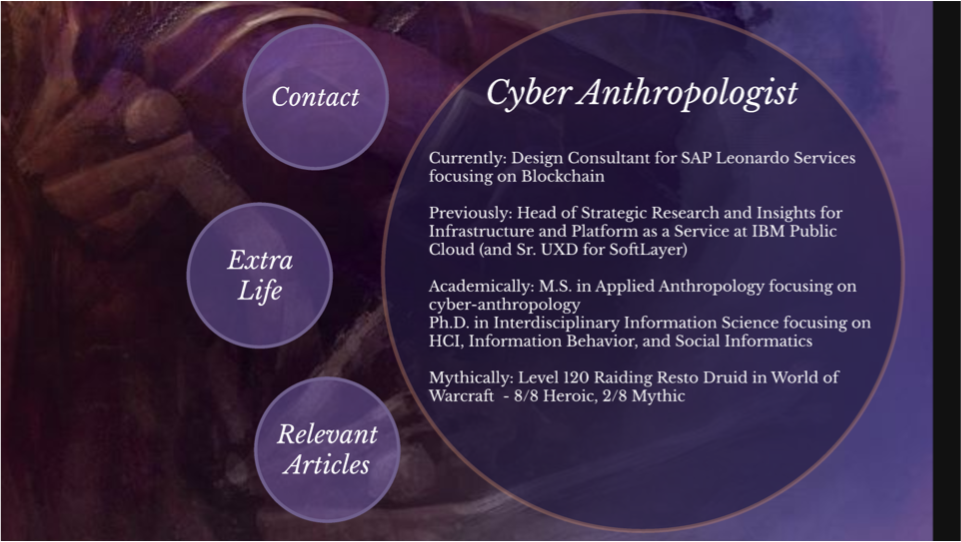
Who am I My name is Dr. Diana Hubbard. I am currently a design consultant for SAP specializing in Blockchain (I’m now a Director of Research for Hilton). In my previous role, I was the head of strategic research and insights for IBM Public Cloud. You can also tell I’m also an academic by the length of my title and my strategically placed colon.
For the past 11 years, I have had the opportunity to pull together successful research, design, and development teams in multiple organizations ranging from Software as a Service to Infrastructure and Cloud Services to now with Edge Technologies.
I contribute the success of these teams to lessons learned from World of Warcraft.
Academically I am an anthropologist and information scientist who has studied gamers, gaming, developers, and open source development communities for the last 12 years.
Druid I am also a max level Resto Druid (I main a horde druid these days) in a newly built high-end raiding guild (I’ve changed guilds since then) in World of Warcraft.
Though I’ve played for the last 14 years and been a part of many raid teams, this one was put together specifically for the expansion that just came out in August.
I raid with up to 19 other people 3 to 4 nights a week for 3 to 4 hours at a time. This is on top of my job and taking care of my family of 5 including 3 children, as well as our 3 dogs, and our home.
Learning Today I am going to highlight a few things I think people like us, who build and manage teams, can take away from these organically grown communities of practice who come together both inside and outside the game to voluntarily put in a lot of time and effort to successfully collaborate in highly intense situations toward a common goal.
And they do this in the face of failure and defeat and the possibility of getting nothing but a virtual repair bill for their hard earned broken digital armor.
Since my time is so short (I only had 20 minutes) I will only be able to go into these at a high level but I will provide a link at the end of to my blog where I will talk about it in detail and link to this presentation. (<– this is just now happening)
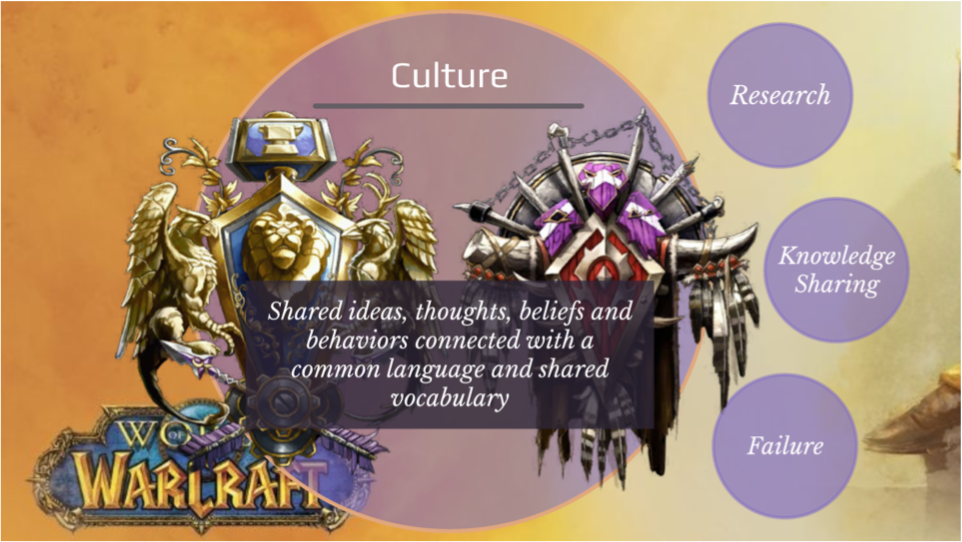
Culture: Shared ideas, thoughts, beliefs, and behaviors connected with a common language and a shared vocabulary
Culture Let’s start with Culture.
What is culture anyway. Is it where we live? What we do? The clothes we wear?
As an anthropologist, especially one who studies geographically dispersed online communities, I obviously have an opinion on this. I define it as shared ideas, thoughts, beliefs, and behaviors with a common language and shared vocabulary.
This is an important distinction because raid teams do not normally all hail from the same countries or even speak the same first language, but they all know, understand, and have a passion for Warcraft. The same can be said for many of our product teams in relation to our businesses.
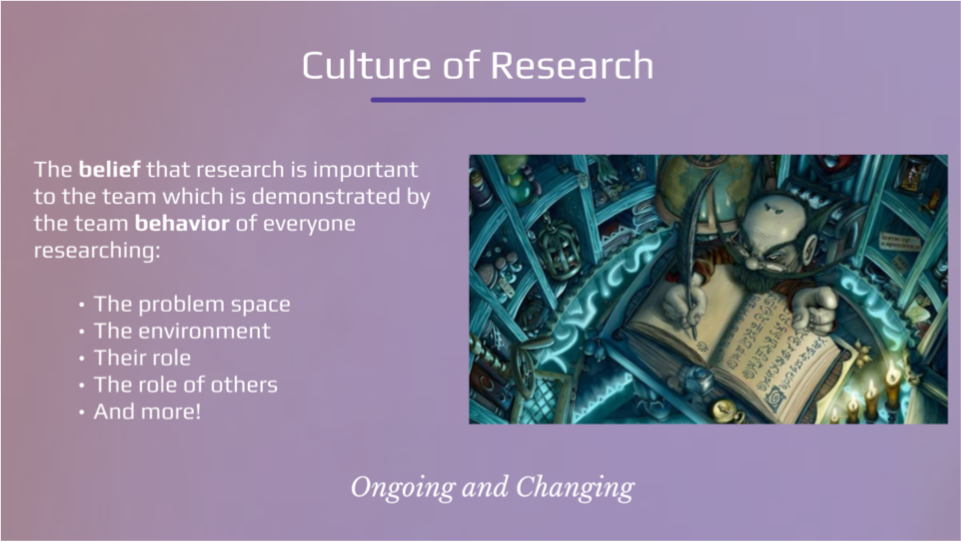
Being a cultural anthropologist, it is no surprise I have found culture to be an essential element of successful teams. There are many ways it is important, but for the purposes of this talk I’ve distilled it down to 3. Culture of Research, of Knowledge Sharing, and of Failure.
Culture of Research
Research Considering research, the most essential part is that everyone does it. And this isn’t necessarily user research activities, though as a UXR I do highly recommend all members of product teams participate in at least some user research activities.
In this case, research is a bit more high level including topics such as the problem space. Everyone conducting some sort of research at this level not only helps individual knowledge, but it also improves the overall interaction of the team as it helps level the playing field and gets everyone on the same page.
The purpose is not necessarily to get all of the answers, but to know what questions to ask. Lastly, it should be noted that research never stops. The game is always changing, as projects do, so research is always ongoing and evolving which is why knowledge sharing is important.
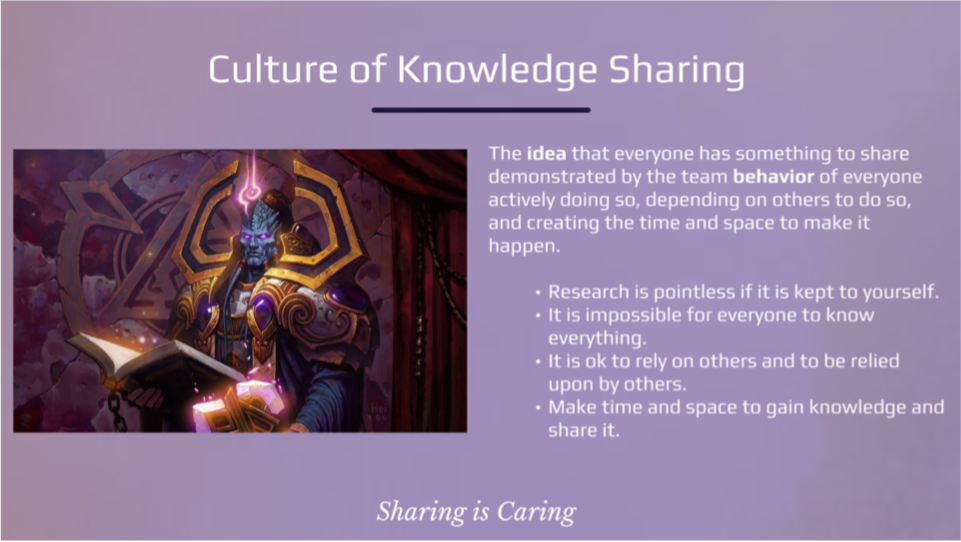
Culture of Knowledge Sharing
Knowledge Sharing Knowledge sharing is fundamental to the progress of the team because not everyone can know everything at all times. I don’t know if you’ve ever seen a mythic raid boss fight, so imagine your favorite sports game and add earth quakes, volcanos, lava, tornados, hurricanes, and tidal waves all happening while your team is trying to score a goal and that might give you some idea of how much is going on any one time that everyone needs to have some knowledge of.
Though knowledge sharing may seem like a small thing, it creates an environment where team members come to rely upon each other and learn how to be relied upon, which is important when it comes to progress through failure – something that is a given for a mythic raid team.
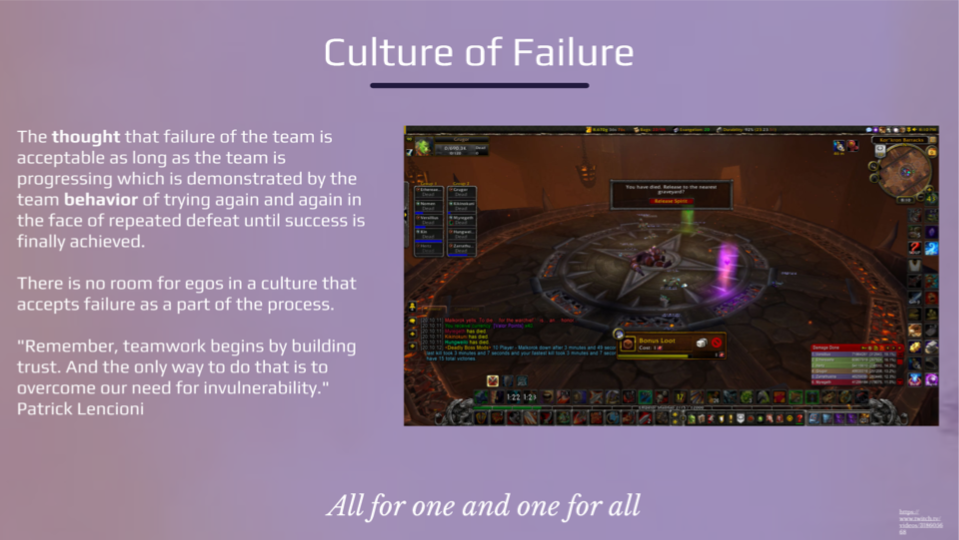
Culture of Failure
Failure It is nearly impossible for a team to walk into an encounter or a problem space for the first time and be successful.
We should all know this going in as it’s what we signed up for. Those with egos do not make it very far in mythic raiding because you have to be ok with giving up your invulnerability. You have to be willing to fail with the team if you’re going to ever succeed with them.
There have been nights where we have died an upwards of 30 times, half of them trying to get past a single boss.
However, every time we died we got a little further and learned a little more and all those little failures are what helped us succeed in the end. The important part was we kept going and kept each other’s spirits up as we did, which is a very important skill to have.
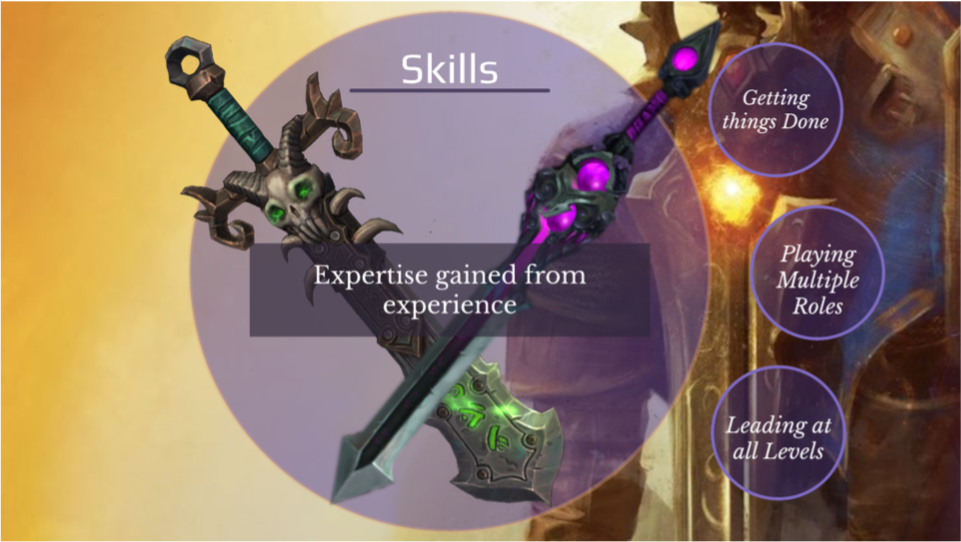
Skills: Expertise gained from experience
Skills Skills can mean many things, but for this talk I’m going to keep it simple. I love the straightforwardness of this definition – expertise gained from experience. It plays very well into the three skills I consider essential for raid and product teams, which are getting things done, playing multiple roles, and leading at all levels.
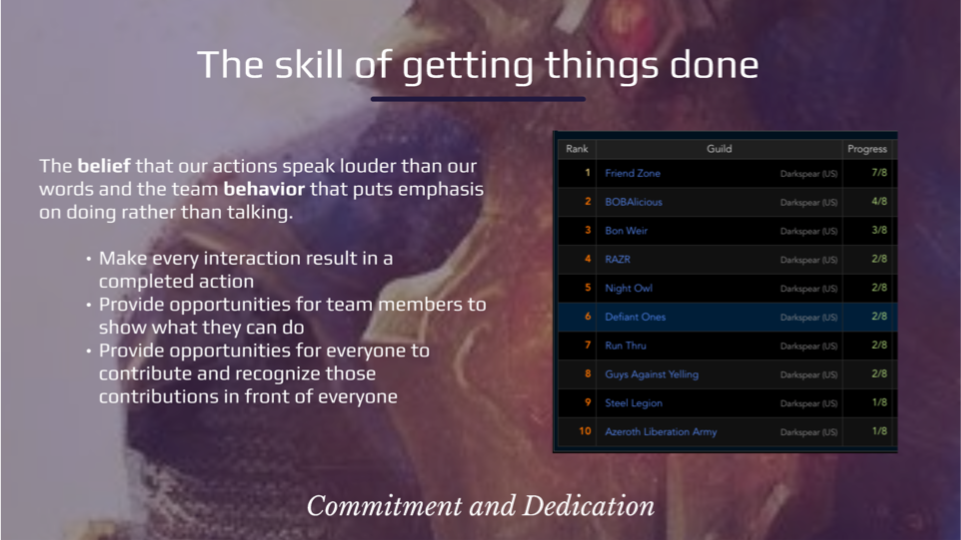
Skill: Getting Things Done
GTD We’ve all heard of GTD or getting things done, but how many of us practice it? How many of us have meetings about meetings or walk out of a meeting having accomplished absolutely nothing?
For a raid team, time is precious. Not only does our chance to progress reset every week, but we all also have lives and jobs and even children fighting for our time and attention. So, when we meet in game it is always with a purpose and a goal and a timeline.
We all want to see our guild name move up the rankings and we all know we have the power to make that happen but it takes commitment and dedication. We will progress only if we show up together and get things done. And to get things done we sometimes have to step into someone else’s role.
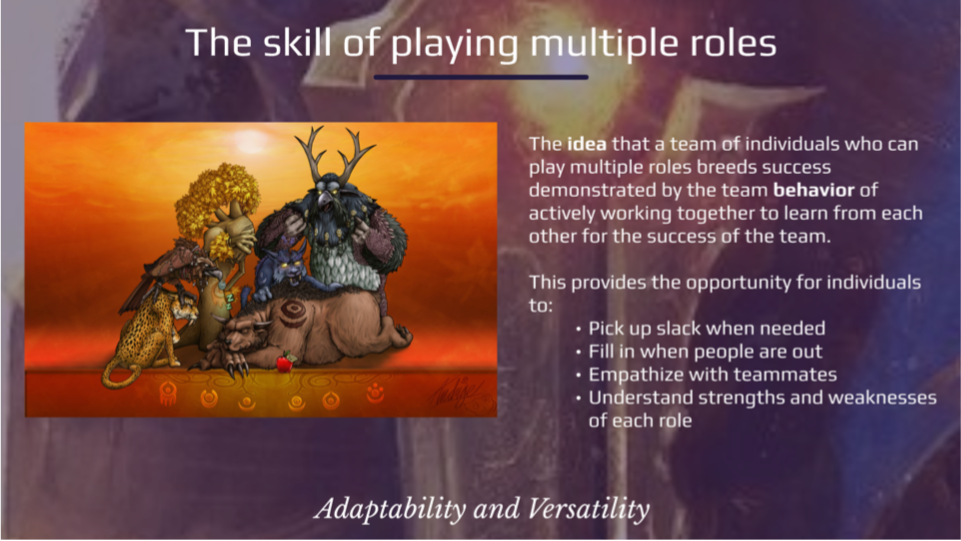
Skill: Playing multiple roles
MultiRoles Having people play multiple roles is not the same thing has having a team of unicorns. Rather, it is about having a team of people who can pick up the slack when someone is sick or on vacation or the deadline has just been moved up.
It’s about team members who have empathy for each other and understand each other’s strengths and weaknesses. Building a team of people who have both breadth and depth creates an environment that is both adaptable and versatile making it an exceptional place for leaders to grow.
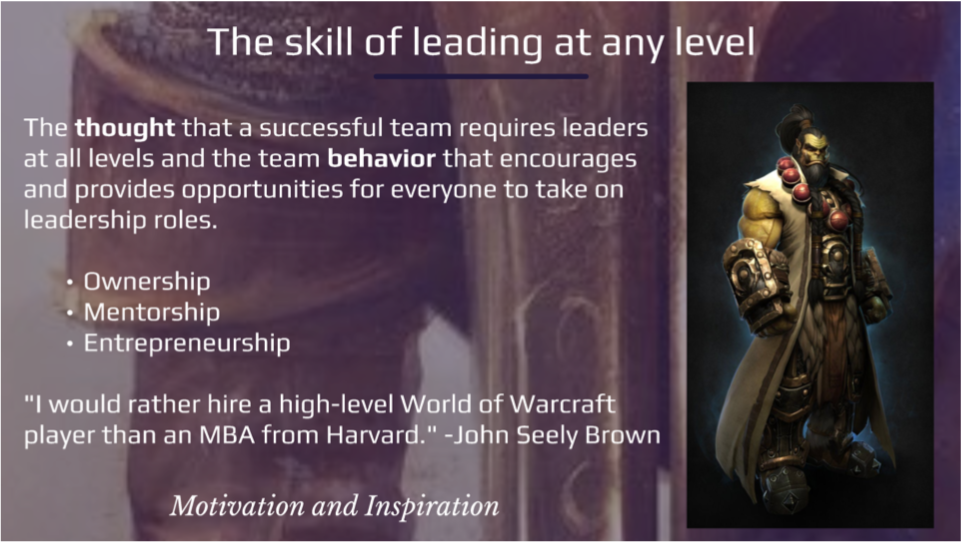
Skill: Leadership at all levels
Leaders Leaders who strive for adaptability and versatility need other people who are willing to take on leadership positions within their teams in order to lead successfully. This is more than delegation. It is about creating a supporting atmosphere for team members to own their contributions and to mentor others.
It’s about creating a space where they feel empowered enough to do new things and take risks to improve the team’s chances for success. Encouraging leadership at all levels provides ample opportunities for motivational and inspirational interactions.
Interactions: Reciprocal actions or influences
Interactions Interactions are simply reciprocal actions or influences. It’s the reciprocity that makes a difference for collaboration, communication, and critique.
Interaction: Organic Collaboration
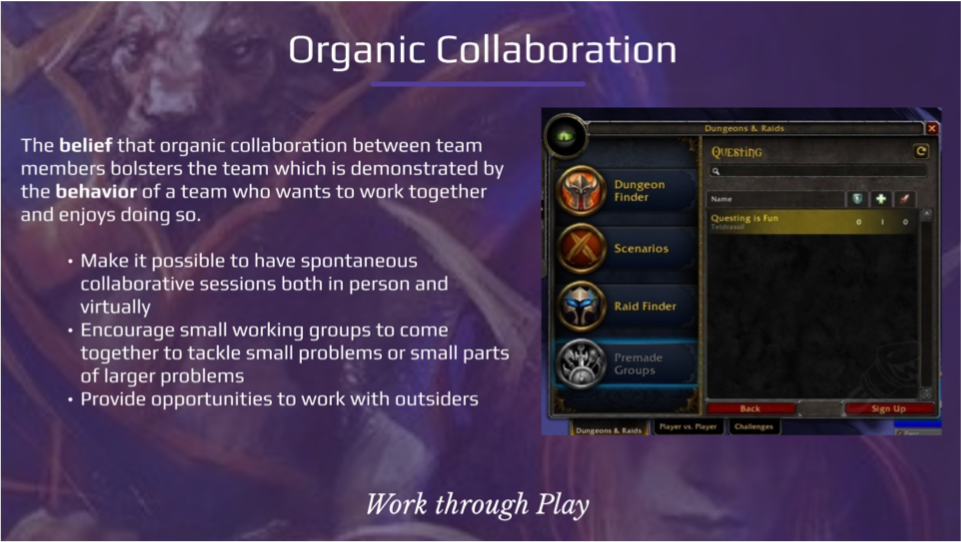
Collaboration Organic collaboration may seem a bit strange, but we’ve all had those scheduled collaborative sessions that weren’t really collaborative at all.
The idea here is that people get better at what they do and they produce better work when they are able to spontaneously collaborate as needed, work together in smaller groups on smaller problems, and work with people outside of their team for additional or missing expertise.
In WoW we call this pugging or creating a Pick up Group. Doing these things increases team relationships both internally and externally, which improves the success of the team overall especially in communication.
Interaction: Free and open communication
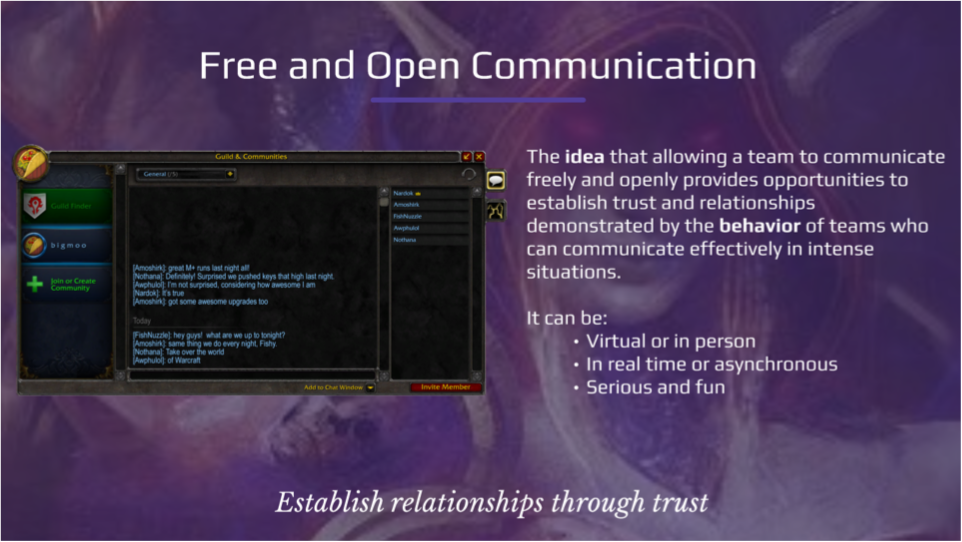
Communication Free and open communication is essential to the success of every team because it helps build relationships through trust which is needed when the situation gets intense.
The key here is to establish a method of communication everyone can participate in and to make sure it is kept active and relevant. That said, though we may want to try to keep everything on topic, I always recommend a time and place for off-topic chatter because people matter and this is where you really learn what matters to them.
And knowing people is really important when it comes to critiques.
Interaction: Actionable Critique
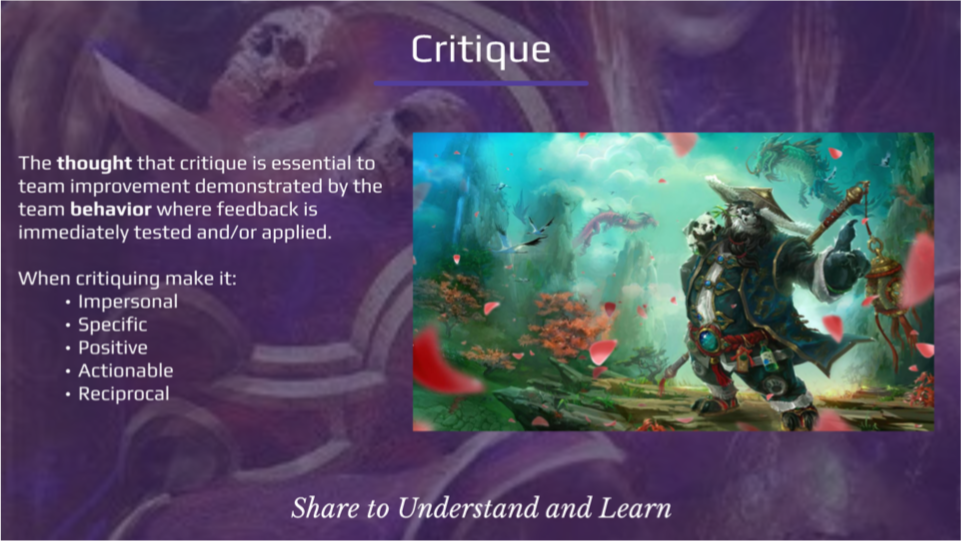
Critique Critiquing can be difficult to do well and even more difficult to take, but when it is simply a part of the team’s regular interactions it becomes normalized and accepted and even sought after. Giving and accepting critiques is only the first step.
The step that really counts is immediately testing or applying the feedback. This should be done even if the feedback seems silly or counter intuitive because if nothing else it gives you a different way of looking at your problem, which may be what you need to make a difference and that may be all it takes to get a ding.
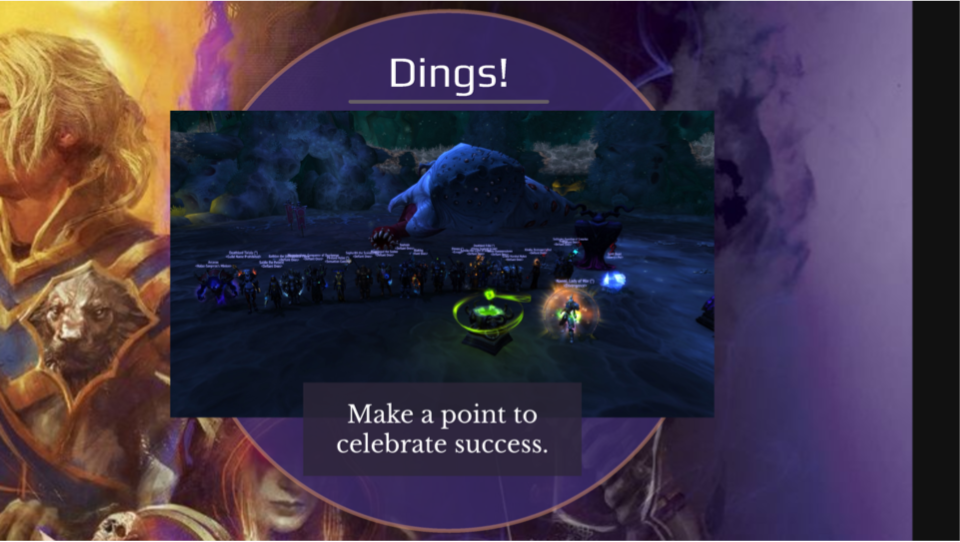
Dings: Make it a point to celebrate all success big, small, and in between
Dings What’s a ding? Traditionally a ding is what players in WoW would refer to when they completed a character level. I’ve taken it a step further to use it as a way to celebrate progress. Many of us have likely been on teams working on a project that seems like it never ends, much like an MMO. Dings are useful break up the monotony and to keep people motivated as they mark movement forward. So, I recommend building in dings to give something to look forward to and to look back on.
Note:All images are owned by their owners including Blizzard Activision and are used here in Fair Use for scholarly purposes. This talk was given pro-bono and this information is being shared for free.You can find a portfolio of all of the slides here.
As a cyber anthropologist, I have always been a HUGE champion of remote research. Is it different than in-person? Of course it is. Is that a drawback? Depends on how you look at it.
Being someone who came of age with the Internet (yes – I still spell it with a capital I), I have always been a champion of using it as a tool, especially as a researcher. Does it take a special skillset to be able to connect with people remotely? Yes, of course. Does mean it can’t be done? No, not at all. It takes a hell of a lot of empathy and reflection and ACTIVE LISTENING to make it work, but in my experience, it is well worth it. Just being there, in any shape or form, can make a world of difference sometimes. You might be very impressed with the depth of relationships, connections, and knowledge you can glean through a computer screen if you just give it a chance.
Remote research has been around a while. The work I did for my Bachelors (2006) Masters (2009-2010) and Ph.D. (2015-2016) all incorporated remote research of some sort, which was based on my predecessors from the early 2000s (Christine Hine, for example). I also incorporated it as a part of my work at SoftLayer/IBM (2009-20018), SAP (2018-2019), and my team did so at Hilton (2019-2020). It CAN be done as long as you’re willing and able to give it a try and understand that being able to identify with our fellow humans doesn’t always require physical presence.
You may even be able to delve further researching remotely than you ever could in person simply because communicating via a computer screen provides a comfort to some that they can’t get in any other way. There are a lot of people who prefer to communicate at a distance for one reason or another. Let’s not reject or forget about them because they communicate in a way different from most of society. EMBRACE it and you just might achieve a much deeper connection than you ever would have in a manufactured lab or a corporate workspace.
I know a few researchers who are in unfamiliar territory right now and my advice to them is that they already have the skills they need, they just need to understand how to transfer it to an online context. All people want to do in the world is connect with others (whether they admit it or not). Figure out how to be that conduit, and you can do wonders for everyone from research respondents to co-workers, and friends.
Looking for tips and tricks to make this work? I’m on furlough, so almost always available virtually! Contact me if you need advice, guidance, mentorship, or even just a sounding board. I’m happy to help in any way that I can.
Better late than never right? I suppose a furlough is a perfect opportunity to catch up on posting some of my presentations here. To that end, I’ll start with the latest I gave twice in the fall of last year. Thank you to all who came and for those who didn’t, I’m happy to share the slide deck. Unfortunately it is very large due to the videos I have within it, so I am not able to post it to any slide share sites and you may have to download it to view it. I’ve captured what I feel are the most important points below for those who simply want the highlight reel.
Beyond Accessibility – Dr. Diana Hubbard, 2019
This is a presentation I gave twice last year on inclusive design. Why did I choose this topic? Well, it’s become quite the buzzword that people often use without truly understanding what it is. The most common notion I’ve seen is that it is simply designing something with accessibility in mind. Unfortunately, that just gets to the end result and doesn’t necessarily do it well.
The simple condensed message of this presentation is that inclusive design is about the process of design. It is about INCLUDING people from diverse backgrounds as well as those with diverse abilities in the designing activities and not just as a potential user for which the product or service is designed.
A few of key points:
Innovation starts with people and there is no better place to look for ways to innovate than to consider people who are differently abled
People often start from a problem solving mindset and solutionizing right from the beginning when they would be better off if they went problem finding first. When you think you already know the problem and already have a way to solve it, you end up with tunnel vision which does nothing but exclude all of the other possibilities where you could truly innovate.
The best way to describe inclusion is that it is the opposite of exclusion.
Go problem finding with people who are used to finding problems (hint: those who are differently abled or come from traditionally marginalized backgrounds)
Being differently abled can be permanent, temporary, or situational – if you design for it, you help EVERYONE.
Our most precious resource is attention and it is very hard to PAY that when you already start with a smaller amount of it due to attention divestors including but not limited to differing experiences with:
Mobility
Hearing
Sight
Touch & Fine Motor
Speech
Langauge
Cognition
Finances
Economics
Emotions
Environment
Attention Investors include but are not limited to:
Accessibility: Attribute, Goal, Result
Inclusivity: Mindset, Method, Approach
Universal Design: Attribute – making something usable with no adaptations
Open Design: Process, Method, Approach
Everything comes back to starting with PEOPLE
Key take aways
It’s a mindset not an attribute
It’s not just about the what, but also the who and the how
Going problem finding is essential to better understand problem solving
You can start right now
Start right now by:
Thinking creatively – as Papanek said, try designing for “the poor, the sick, the elderly, [&] the disabled.” (Design for the Real World, 1984)
Working in interdisciplinary teams (include designers, engineers, product owners, researchers, and the people for whom you’re creating the product or service)
Looking beyond your particular product or service (the problem you’ve found has likely been approached by others in unique ways you can learn from if you simply look beyond your own market)
Learn from the current environment (ecological, social, economic, and political)
Integrate your designs (how does this product or service fit within the user’s entire experience, not just what your particular focus does but what the user needs it to do along with everything else they have going on in their lives)
Review your designs after release (both quantitatively and qualitatively – watch people actually use it in the field in real situations, you’d be amazed at what you will learn)
Lastly, and this is very important to me – there are some people in the world who suggest Designers with a big D (those who hold that title) should be Gatekeepers to keep out bad design that is proposed by designers with a little d (everyone else in the world as we are ALL designers).
I suggest that it is our job, instead, to be Gardeners (thank you to Jorge Arango). It is up to us to help cultivate all design ideas into ones that will grow and evolve into something great for everyone and to keep tending to them as design is never a one and done event. In the end we should be open to new ideas, even if we didn’t come up with them ourselves. Let’s mix our new inclusivity mindset with a growth mindset. Designers do not corner the market on good ideas, rather, we are good at bringing them to life.
Though we may not be able to change the world for everyone, we can always change it for someone — especially when we include them in as a major player in seeing that change through.
End Note: If you can download and view the deck, I highly recommend it. It has great examples, and videos, and firsthand accounts. I may separate it all out as its own portfolio piece at a later date for easier review. I’ll post an update here if I do.
Update: Here is the portfolio so you can view all of the slides without downloading the presentation. Of note, there are videos in the full presentation that are only located there. I feel they are very powerful and add a lot to it. Links to all but one of the videos are provided in the slide descriptions if you want to try to view them that way.
P.S. I used a lot of Papanek quotes throughout this presentation. If you haven’t read Design for the Real World, I highly recommend it. It’s over 30 years old and thus some of it may be read in a harsh light given today’s enlightened view on many things, however, it is still relevant.
As we go into the new year, I wanted to give a heads up as to a hiatus on any future speaking engagements. Given that I do all of these pro bono (completely unpaid) and they take a lot of time and effort, I am unable to do any more at this time. I have just changed positions and my new one is much more demanding than my last, which leaves me no free time at the moment to engage in any extra work. Thus, I will have to forgo any new ones for the foreseeable future while I focus on getting settled at the new gig.
That said, I will hopefully be updating this blog with all of my presentations from the last 18 months so that the content (including commentary) is accessible to everyone. Since I give all of these talks for free and I do all of the work myself, this will be me giving back to the design and research community. Once they are posted, feel free to share! Side note: I can’t guarantee when they will be posted as this is always a hectic time of year for a family of 5. If there is something specific you’re looking for before I post it, please reach out to me.
Considering blog updates, I’ll continue to post about research including part two of the Breakdown of a User Research Project as I have time. Beyond that, the posts may be few and far between. If you are a college student/new to industry person looking for mentorship, please feel free to use my contact form (don’t email me directly as it will likely end up in junk). I am always happy to help people out and of course there is no cost to that. We only excel as a community by lifting each other up and helping others along the way. I am happy to do what I can to promote design and research as much as possible and there is never any charge to do so.
If we don’t chat before the end of the year, here’s to a great 2020!
So, a lot has happened since my last post. The most important of which is that I have changed jobs and have moved out of the tech space and into the hospitality one as a Director of Experience Design Research. I am looking forward to lots of new, beautiful, and exciting challenges ahead working in a space I’ve never been a part of before.
That said, if you want to see something I worked on while I worked in the blockchain space, check out this Business Insider article on the work my team and I did for Coca-Cola. I was the design consultant that led the research/design thinking portions of the project and I did the designs and prototyping for the application we created that pulled data directly from the ledger for reporting insights.
DFW Beyond: November 18th 2019 in Plano, Texas
In addition to that, if you missed my talk on Inclusive Design at Big Design I will be giving it again at DFW Beyond this coming Monday November 18th at 1:45 pm.
If you can’t attend, or you attended in September and are still waiting, my slides will be posted either late next week or just after Thanksgiving. I appreciate your patience!
This will be a quick (well maybe not so quick) review of a user research project that was conducted in March of 2018. The designs that were tested during this and other research projects that were conducted during this time period helped the design team move forward with work that won design awards this year.
As in most cases, the research work that went into completing the designs is not something that is likely to be publicly recognized. So, I’m taking the time here to showcase one particular research project in order to shed light on the process and the effort that goes into making something like this happen. This series of posts will be a review of how we conducted, analyzed, synthesized, reported, and presented on this research to help inform both immediate design direction as well as strategic decisions.
My role for this research was the head of the research team. I designed the research study, worked with my team to conduct the sessions, and then worked with a junior researcher to analyze and synthesize the results. The junior researcher and I then worked together to writeup a results and recommendations report and we put together a presentation for leadership that we then presented to multiple levels.
Designing the Research Project
Truth be told, I was pulled into this project approximately a week before the research was to be conducted. I had very little latitude in what I could do to pull it off in such a way that it would be useful, so I did what I could with what I had. I was told we would be conducting research at our company’s annual meeting and that we would be doing so with “Inner Circle” companies. Or, those companies that paid a bit extra to see early work prior to release.
The design team originally wanted to hold a focus group, which I vetoed because given our timeline, we would not be able to recruit properly for one to be successful. (Side note: I generally dislike the group think that happens in focus groups. I find the data that comes out of them to be less useful than doing multiple individual research sessions and I would rather take the time to do it right than waste time on data that I can’t use.) Instead, I recommended that we do prototype walkthroughs with different companies who came to our three scheduled 1.5 hour sessions. Since there were four of us going, I suggested we could each take an interviewee and record the process so that it could be transcribed and analyzed later.
I provided a walkthrough procedure we were all to follow including how to set up the interview, the questions to ask, how to ask the questions, and how to probe as needed. Each interview was to take 20 to 30 minutes which meant that with the four of us we could get about 24 interviews. This is a pretty large sample size for this type of research. The thought was we could come together after each session to see what parts of the path were reviewed and then start users on separate paths during future interviews to make sure we captured data on everything possible. As long as we got 3 to 5 users to go down each path (there were 3 main paths), then we would have enough data to move forward with.
Had I been able to design the research early on, I would have gone out of may way to recruit different types of users for each path and separated each round for each path.
Prepping the Prototype
I also reviewed what we were to be doing a prototype walkthrough on and made multiple suggestions to the design team in order to make it a more successful artifact. Note: I highly recommend this for all researchers. If you’ve never conducted a prototype walkthrough before, please have someone who has done so review any work before it is put in front of a customer.
If a prototype is not prepped properly, especially a click-through one, then the user will end up getting hung-up on how the prototype works (or doesn’t) rather than the content within it. Prepping a prototype includes making sure all of the content is consistent from the colors, to the fonts, to the placements, to the images, to the interactions themselves. Even a word being misspelled will cause an issue.
This is one reason why I HIGHLY recommend doing prototype reviews on low-fidelity work. Low-fidelity work is easier to change quickly, easier to keep consistent, and easier to keep a user on-task and in the flow. Once you start adding medium or high fidelity flair, you provide more opportunities for bikeshedding.
I’m not saying not to test high-fidelity work. What I am saying is that it is better if that work has already been tested at a low-fidelity so that by the time you get to testing the hi-fi’s it should result in minimal changes and it should target very specific pieces of the hi-fi work itself and not the content, flow, or interactions. By the time you get to hi-fi, those pieces should already be vetted.
It also helps if you know the material being tested. Full disclosure, I was a designer in the space for nearly a decade prior to creating a research team and conducting this research. Additionally, I am a technical designer and researcher. I have a very technical background (from hardware support, to server administration, to web development), so not only do I very much enjoy this work, but I also have the background to be able to do it successfully. Though it is not a requirement for researchers to be super knowledgeable about what they are researching, I believe in the tech space, it certainly helps.
Conducting the Research
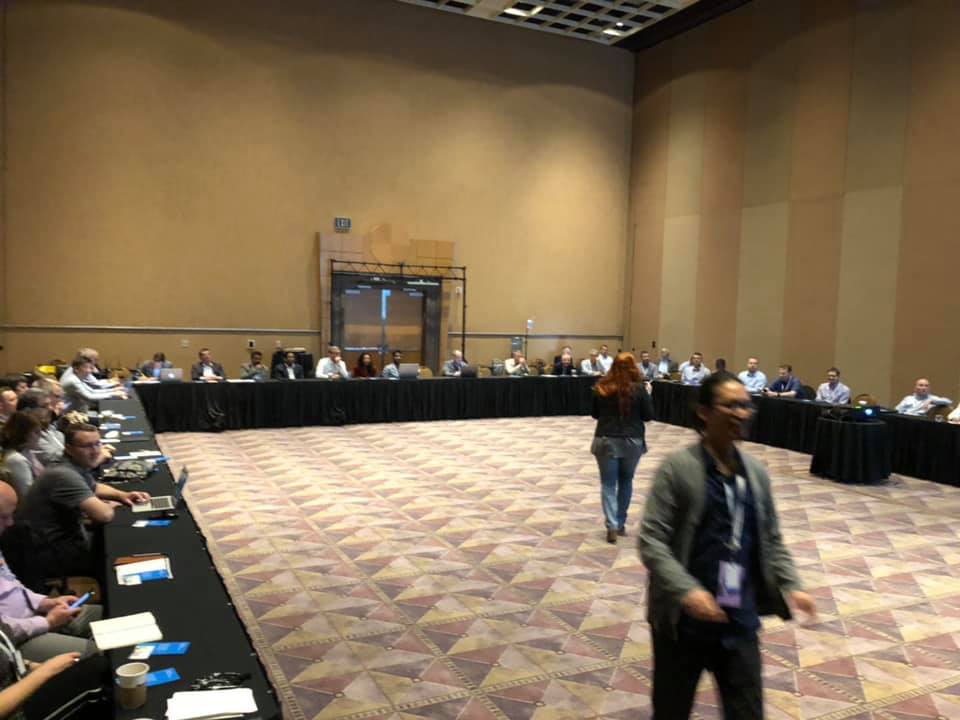
Me walking toward the crowd mic in hand – we got this!
Of course nothing ever goes as it is supposed to. We expected maybe a few companies to trickle in during our sessions as we were in high competition with multiple other sessions being conducted at the same time. That, and who wants to do a prototype review? Well, apparently a lot of people do.
We walked into the room where our session was to be held at 8am and found it FULL! We had over 50 people in there to start with and most stayed the entire 90 minutes. The team I arrived with started freaking out a teensy bit, so I grabbed the mic and took over. I introduced my self, what we were doing there, and then asked for a volunteer from the crowd to drive.
Thankfully, a volunteer stepped up. We put a mic on him, aimed a camera toward him and the prototype we projected on a large screen behind him, and then I led the prototyping session with everyone at the same time. Note: We recorded him, his face, and his voice with one camera and we recorded the session on the computer at the same time.
So, did this turn into a focus group? No. That was the point in having a driver. We let him take the wheel and proceeded with him leading us through his own path. As he went through, members of the audience had their own questions, too. So, I took a mic around the room and got their input as well.
The most interesting part was we had a lot of different types of people from a lot of different types of companies in the room, which meant they all had a different use case or need. Hearing one company’s use case would then prompt another company to engage with them and then state how their’s differed or resembled the previous. Having a driver allowed us to pull people back on track as needed, but we provided a bit of leeway as was necessary if the questions were relevant and had bearing on the current or future design states.
Single-user prototyping session
The second session was right after lunch and that went a lot smoother as there were much fewer participants. As they entered the room we had them sign up for a session and provided them a time slot to return. We conducted 10 individual interviews during that 90 minutes.
For these, we simply recorded the screen as they clicked around the paths that were of interest to them. What we found during these sessions was that users were looking for more of a guided tour of our product and wanted to ask technical questions on existing interfaces rather than prototyping up and coming ones.
We decided to go ahead and do the room-wide prototyping session for the third round due to the fact that it was the last of the day and it was considerably smaller than the first session. Turned out we had a lot of networking experts in the room for that one, so it was a much different conversation. Overall, we had more than enough data by the end of the day to move on to the analysis and synthesis stage. I’ll save that for part 2.
Ahead of the conference, I want to give shout out to the three women who helped contribute to my presentation on Inclusive Design for Big Design this coming weekend. As a fully-abled person, I know that my experience and understanding is minimal when it comes to the needs, experiences, thoughts, behaviors, and beliefs of people who have to navigate a world very different from mine. With that in mind, I reached out to see if any people who were differently-abled had a story they wanted to share to help show how powerful inclusive design can be. This resulted in three interviews with three amazing women all doing what they can to help inform the rest of us about what it is like to live in a world with, stealing the phrase from Kat Holmes, mismatched experiences.
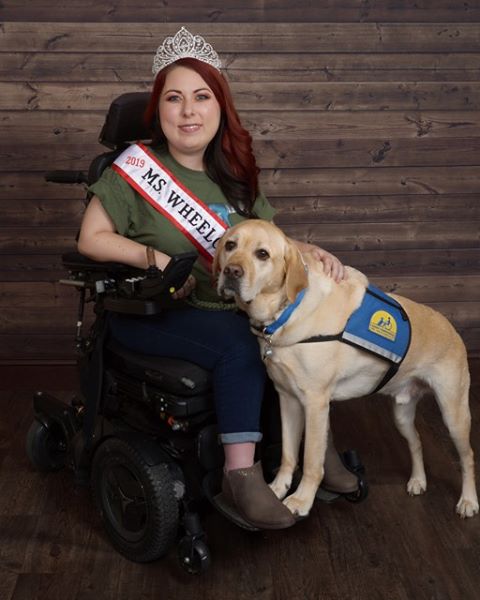
Lauren Taylor and her dog Buchanan
Lauren Taylor – Ms. Wheelchair Texas 2019
Lauren was referred to me through Facebook via a mutual friend. She is a master’s student in the UNT – Department of Rehabilitation & Health Services rehabilitation counseling program and is studying to receive her license as a certified counselor. She wants to specialize in physical disabilities. Lauren was diagnosed with Congenital Muscular Dystrophy at the age of one and has been in a power chair since the age of three. In her spare time, she volunteers with Canine Companions for Independence alongside her service dog, Buchanan, by raising awareness about the necessity of service dogs and educating others on service dog fraud. Lauren works closely with UNT to make it more universally designed for all students. Her work with Classroom Support Services has enabled her to personally create desks for fixed seating classrooms that are inclusive to every student and are permanently installed, rather than a temporary and separate accommodation. She currently works at REACH, Inc. of Denton as a Youth Transition Specialist, helping youth with disabilities transition into and navigate the adult world. Her platform is Universal Design for Inclusion because of her passion to create a barrier free world where people with and without disabilities can coexist with ease. She hopes to bring the concept of universal design across Texas to businesses, schools and communities to create environments of equal benefit to all members of society. (src)
She provides a great introduction to herself and her platform in this video. Please, if you have a chance, take a look!
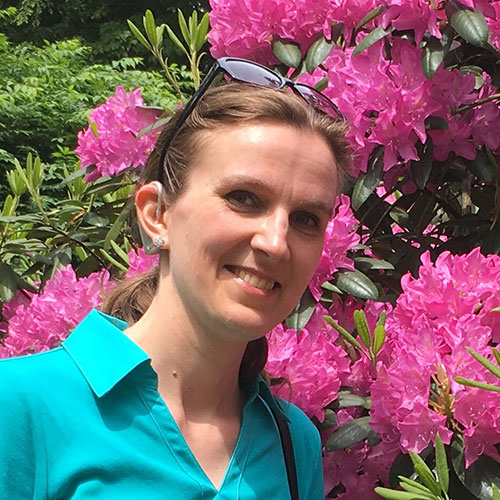
Svetlana Kouznetsova
Svetlana Kouznetsova
I met Svetlana back in 2012 at an Information Architecture conference in New Orleans. I found her to be charming and funny and really enjoyed the little bit of time we were able to hang out. She is an author, a speaker, and a consultant as well as the founder of Audio Accessibility, a captioning and communication access consulting firm. She wrote a book on captioning as an art form, which you can find here. She also hosted her own TEDx talk on the same topic where she explains that being inclusive accessible is not only good for people, but it is is also good for business.
Ainslee is a fellow anthropologist who lives in Australia that I have known for about a decade. She uses her anthropology background to consult with businesses on accessibility.
In her own words “[h]aving a lived experience of disability gives me an insight into the issues faced by people with a disability. It also gives me an insight in to some of the problems faced by disability service providers and businesses outside of the sector, in providing appropriate services. As an Anthropologist, I have the tools available to provide disability service providers, and other businesses that wish to utilise my services, access to consumer insights that will not only help improve services but will strengthen relationships between businesses, both within and outside of the disability sector, and consumers.”
She is also a power lifter who jokes that she “skipped leg day 1 too many times”.
Thank you to all of you!
I feel honored and privileged that you all took the time to work with me on this. I learned a lot from all of you and really appreciate all that you do.
I am a presenter at the Big Design conference next month in Dallas where I will be doing a presentation on Inclusive Design beyond Accessibility. There just so happens to be another talk on Inclusive design at the same conference, so I am changing my tactics a bit from presenting research I’ve done on my own to reaching out to the masses to gather stories of people affected by exclusive design that the general public has no knowledge of, is not affected by, or completely ignores either out of ignorance or inconvenience.
Inclusive Design Presentation, Saturday, September 21st at 4pm at Gilley’s in Dallas, Texas
As an anthropologist and a designer, I feel this particular intersection of people and design is a perfect fit for anthropological work. I am interested in learning more about people’s experiences around exclusive design concerning cognitive, emotional, mental, physical, environmental, economic and financial, as well as gender and race (and any combination). The exclusion can be either physical or digital (or a combination). All exclusive design is important to me. I am also interested in learning about inclusive design that has greatly affected people or even design that came close or tried to be inclusive but missed the mark.
To that end, I am currently recruiting people to share their stories. If you would like to share your story, please contact me. At the moment, I am doing email interviews but I am open to communicating in what ever way is easiest for you. Please note that any information you share with me will be data I will potentially share in my presentation. You can choose to remain anonymous or attach your name and image, what ever is most comfortable for you. As a note, there is no compensation associated with this research. However, if I use your stories, I will attribute you in anyway you see fit and you will receive access to my presentation to share as you wish.
All of my research needs to be completed by September 14th. So please reach out to me as soon as possible. I look forward to hearing from you!
I am frequently approached by students, as well as other professionals looking to further their career, on how an interdisciplinary approach has directed my career and where I hope to go from here. It’s been a while and job change or two since I last wrote about this. So, I thought I’d take the opportunity again to delve into my particular career path, lessons learned, and how I combine academics with technology to provide interdisciplinary insights into both research and design.
Buckle up because this is going to be a long post! For a more succinct summary, visit my online CV and portfolio.
In the beginning…
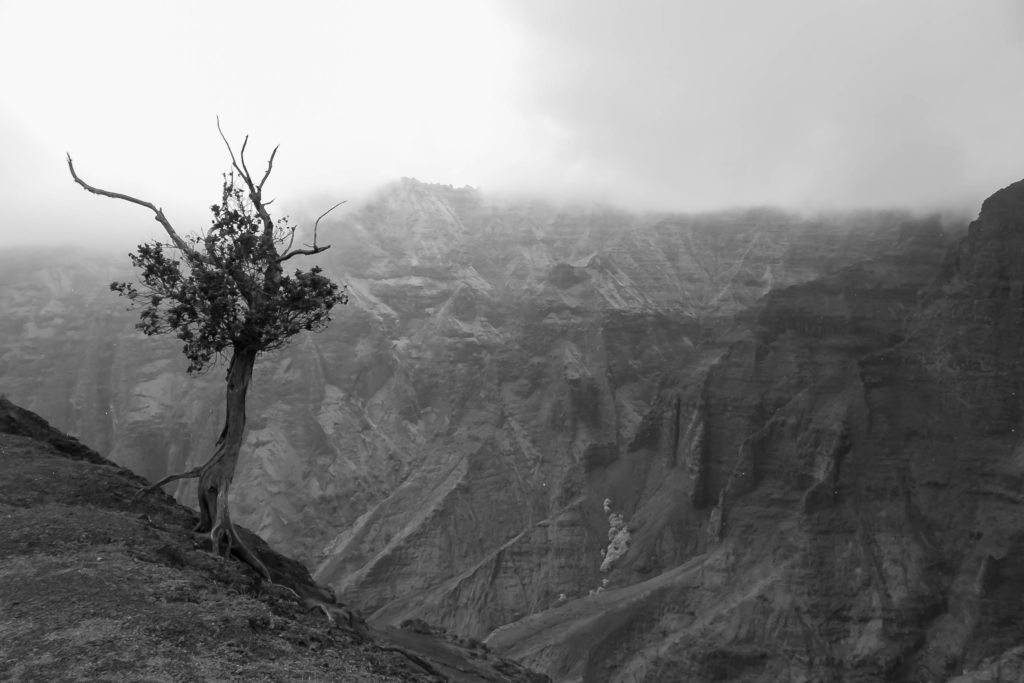
Tree at Waimea Canyon- Kauai, Hawaii – 2016
I started in photography back in the late 90s. And by photography I mean film and darkrooms and medium format cameras and black and white and doing a lot of things by hand.
It was the subject of my first degree (along with graphic arts) and I also worked at pro photo labs (using paint to hand touchup color printed photos or getting sprayed in the face by bleach bypass are things I’ll never forget) for a bit before landing my first job in the computer industry.
Photography taught me a lot of things including patience and technique are more important than hardware or software. I also learned about light, contrast, textures, movement, color theory, focus, and layout — all of which I continue to use to this day.
Darkrooms are one of my original happy places, and though I have yet to watch Stranger Things (hey! I don’t get to watch a lot of TV with all of the other things I have going on), I do appreciate the fact that apparently, they had a darkroom scene. Maybe some interest will spike again. It’s retro now, so that makes it cool, right?
Photography to… Computer Customer Support?
My photography degree also included graphic design and I’m talking old school graphic design here where it was meant for print, not the web. My photography skills blended well with this subject and I also learned things like Quark Express, Photoshop, Illustrator, and more. In addition to the applications, I also learned my way around a Macintosh and this is how I jumped into technology.
Turns out, I had quite the aptitude for working with computers (even though I didn’t grow up with them or even own one of my own until 1999). Here is where chance met happenstance. At the time, Apple had a call center in Dallas and I knew quite a few people who worked there. After talking about needing a new job, I was given a Mac for Dummies book, told what chapters to read, and sent in for an interview.
By Source, Fair use, https://en.wikipedia.org/w/index.php?curid=34249068
I was all of 19 at the time and was still working on my first degree, but in those days a bachelor’s degree was not required for work like this. That, and no one had any experience. So as long as you showed aptitude and had a good attitude, you were given a chance. I took that chance and ran with it.
I worked there for a little over a year and in that time I learned how to support every single thing Apple made from monitors to printers to all of their desktop computers including the G3 and OSs 7, 8, and 9. I went from level 1 to level 2 support and then I became the trainer for all new waves starting on the floor. I left the company just as the iMacs were coming out and they were pulling their support out of Dallas down to Austin.
I followed that job with a stint in the print industry (I’ll get to that in a minute) and then to support at 3dfx, which was one of the best jobs I’ve had to this day. Turns out, a lot of the people who ran the support center for Apple in Dallas moved to 3dfx to do the same thing for them after Apple went to Austin. I was brought on to support the Macintosh video cards, but supported the PC line until they came out. Funny thing was, I was the only one they hired to do Mac support, which meant at the tender age of 22 I owned it all (6 days a week, 12 hours a day, phones, emails, and forums – the overtime was lovely) and I loved every bit of it.
By Source, Fair use, https://en.wikipedia.org/w/index.php?curid=47191447
It was for 3dfx that I went on my first business trips. I was sent to California (my 2nd time ever on a plane) to QA the Macintosh cards in graphic arts applications. While this wasn’t the focus of 3dfx, they understood who their market was and wanted to make sure there were no problems with these, plus I had experience!
I also represented 3dfx at MacWorld 2000 where I was the tech for every computer on the floor and I demoed video game playthroughs before it was cool (PodRacer) to show the difference between the stock video card and ours.
After they realized the workload was more than they bargained for, I then became a trainer at 3dfx (see a trend here yet?). To help me do this with our European teams, I developed a Mac training support program (all screenshots and hotspots hand programmed in HTML), and used it to assist people in learning how to support a Mac without ever touching one. You could say this was the first application I ever developed, though at the time I never thought of it as such.
Gaming has always been a passion of mine, so this was the best of all worlds. Sadly, 3dfx went out of business and I was laid off as the company folded. Though I’ve yet to land another job in the gaming industry, that has always been a goal of mine and I still hope to do so.
Being in technical support taught me a lot that has served me well throughout the rest of my career.
I am not the person on the other end No matter how much I knew about the technology or how many games I played or how I used it for myself, I was not the person on the other end of the phone/email/forum post. Why does this matter? Well, everyone’s experience is different and there was always some variable that came up that I had never encountered. It provided both a learning opportunity for me and made sure that my focus was on the person on the other end rather than the technology or the problem.
There is always more than 1 way to solve a problem I’ve mentioned this in a few papers I’ve written on gaming as a part of my academic career, but it’s so important that it’s also worth noting here. Whether it is technology or gaming or development, you soon learn that when you get stuck it helps to evaluate the situation from multiple perspectives.
Community makes a difference And this is probably one of the reasons why I gravitated toward Anthropology when I started my bachelor’s degree. I learned early on what a difference a community can make in the workplace, online, and around a common goal. Techsupport, especially back in the late 90s and early 2000s, was a place where all three of these came together in a way I’ve only ever seen replicated in open source development and gaming.
Electronic PrePress
I worked in the print industry for about a year. How did I end up there? Well, I answered an ad in the local paper (back when they were printed on paper) for a Mac Tech. I thought, well hey, I’m a Mac Tech. Turns out they were looking for an electronic pre-press (EPP) operator. I told the guy doing the hiring that if he hired me I could learn very quickly and I could fix/support every computer he had in his shop.
And yet again, someone gave me a chance and I ran with it. By the time I left, I was an expert in Quark and Photoshop and a layout artist and I could do random things by hand that no one has to deal with today like trapping colors and sending work to a rip to print to film and evaluating bluelines and finally to printing on web presses in the back of the shop. This all reinforced the focus and layout, and color theory from my photography days and I was able to support it all with my love for technology.
Early Academics
As I mentioned before, I started with an AA in photography and graphic design. After I was laid off from 3dfx I applied for a certificate program in Intermedia arts. Only 10 students were selected based on their submitted portfolios (mine was mostly photography). In that program, I learned digital music (MIDI, ProTools, MOTU), digital photography (digital cameras in 2001! and photoshop), digital video (Final Cut Pro), 3D Animation (Cinema 4D), and web design (HTML). Since it was all on Macs, I also took up a position as the lab assistant. There were no web design degrees at that time, so this was the best I could do and it helped me land my next job.
(Unfortunately, I have almost no examples of this work, as it was all on DVDRAMs, except for this silly digital music piece.)
Software Development
Yet again, someone took a chance and hired me for a job I was not qualified for. This is a definite theme throughout my career. The first step is me taking a chance and applying for a job I’ve never had. I highly recommend this. The worst someone can do is say no. The best is you land an opportunity to shine.
Though I had never had a job as a web developer, not many other people had either in 2002. Everything I knew about web development I had either learned on my own or as a part of my certificate program I completed in 2001. I used all of that to my advantage. Additionally, I knew how to support a Macintosh server and the company who was hiring specifically needed someone versed in Mac.
One of my first workflows – 2004
What started out as a simple HTML programming job turned into developing web applications where I turned paper processes into electronic ones and reduced the duplication of information by linking systems together. I learned Lasso and PHP (and subsequently MySQL) in the process as well as user experience design and information architecture. At the same time, I could apply all of those lessons from photography and graphic arts as well as my technological background. I supported the Mac server and even established the first Wiki system at the company (for the copywriters).
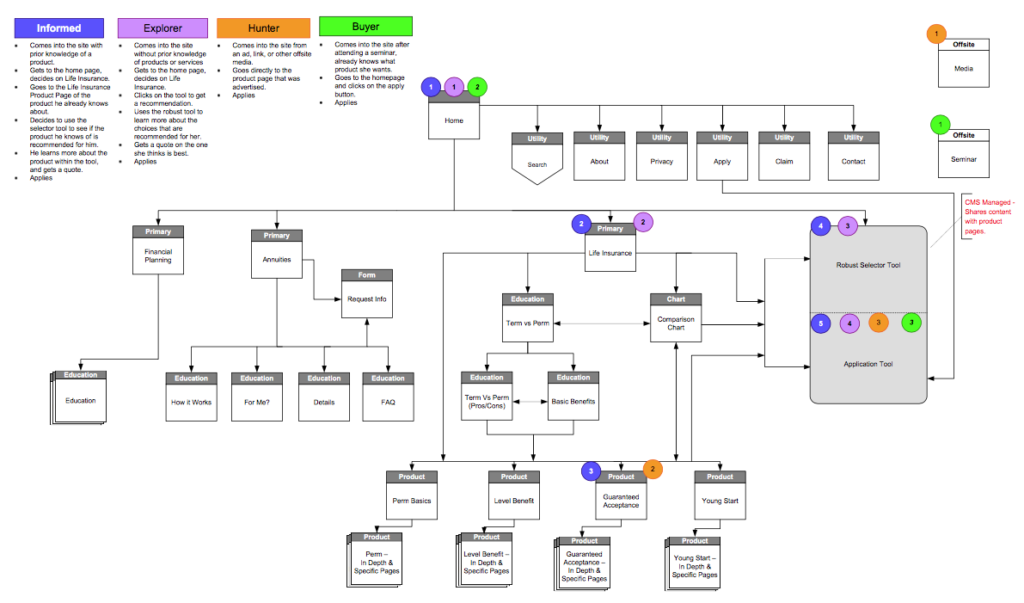
As a part of that job, I developed workflows to help me keep my head straight when I was developing a system and linking them together. Turns out, this was a skill that was useful in other areas.
Bachelor’s in General Studies
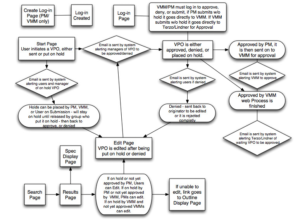
Online Ethnography of a World of Warcraft Guild – 2006
While I was working as a developer, I went back to school in 2004 for my bachelor’s degree. I had to wait until I was an independent student in order to take out student loans on my own (oh if I had known then what I know today). Given that this was now costing a pretty penny, I looked for the fastest way to complete my degree and settled on General Studies where I focused on Anthropology, Psychology, and Philosophy.
Though I didn’t know it at the time, all of that would apply to my career and even my current position. After I started applying my anthropology and psychology lessons to my work, a whole new world opened up. I completed my degree in 2006 and finished with an ethnography of a guild in World of Warcraft as well as an ethnography of ecologically friendly people for Motorola and their EcoMoto project. Being able to do an ethnography entirely online in 2006 and taking a design anthropology class that same semester helped influence my entire academic future (and is what helped to start this blog). Funny side note, my World of Warcraft paper is one of my most referenced papers to this day.
Interaction Design & Information Architecture
Though I had no idea what user experience design or information architecture was when I started my development position, these are where I started focusing my career by the time I was ready to move on. And yes, in both of the following cases, once again someone took a chance on me applying for a job I wasn’t “qualified” for.
Persona Workflow Sitemap – 2007
First, I took a job as an interaction designer at a startup. There was just 8 of us working for this company and that was quite an experience. I’m glad I had it, but I’m also glad I was able to land on my feet quickly after as that company was sold after almost a year.
I then moved on to a position as an information architect at a marketing firm that also developed web applications. There, I became a Visio pro and versed in e-commerce. This was the first time I would work as a consultant and travel in that capacity. I worked directly with Lowes at the time and performed activities such as Card Sorts on-site to help them narrow down their navigation categories.
Quickly, the company learned they had gotten in over their head and they let go of most of their e-commerce staff. My talents where agnostic of technology or industry, so I was able to be moved on to other projects and customers like Samsung and EDMC. In that capacity, I designed everything from landing pages to full-on applications created in Director.
The best part about the job was the variety in the work. The worst part of the job was tossing it over the wall to the next team and rarely ever seeing the finished product. I enjoyed my work and I learned quite a lot, but I realized quickly that it wasn’t the type of position I was best suited for.
As I moved on from the interaction design position at the startup to the information architecture position at the marketing company, I also continued my education and started my MS in Applied Anthropology where I focused on Business, Organizational, and Design Anthropology. (I also started this blog the same year I started my degree.)
My thesis focused on how to Maintain, Sustain, and Grown Online Open Source Communities where I worked with The Fedora Project through an entire development cycle and conducted almost all of my research entirely online. To do this, I was a participant-observer in the community (IRC/mail lists), I conducted 13 interviews with key informants and then created a survey that had over 100 full responses from over 20 countries. After a full analysis and synthesis, I was able to outline ways the community could help improve itself both for its current members and those looking to become a part of it.
While I was working on my MS, I was recruited from my consultant job at the marketing company to work on an HR software as a service (SaaS) application. The person who hired me was a true visionary and though he didn’t necessarily know what exactly I did, he knew he needed one of me. And yep, you guessed it, yet again I landed a job for which I wasn’t exactly qualified.
Role-based Navigation Prototype – 2008
In the full throws of my MS education in anthropology, I pulled out all of my tricks to perform as much guerilla research as I could to figure out what was going on with their current implementation. This included talking to the developers and hanging out in training classes with users. Though I was never given the opportunity to speak to them, I listened to everything they talked about, every question they asked, and every complaint they lodged while undergoing training.
This was an amazing treasure trove of information I couldn’t have done my job without. Based on all of this, I took their completely siloed system (all the way down to the dev teams!) and changed it from a product-focused application to a role-based one that included customized navigation and statefulness. The change in nav was just the beginning of our complete overhaul of the system.
Working for this company was my first introduction to agile (though I’d argue our team of 5 back at my dev job and team of 8 at the startup did it, just not in a formalized way), and it would be the first time I was a single UXD on a very large dev team. These two themes continued at my next job, and I even had a couple of devs follow me over.
Our changes to the system, though drastic, were met with overwhelming success and helped the company win an industry award. You can review the navigation changes in my portfolio for highlights.
Senior User Experience Designer, Information Architect, & Researcher
iPhone Application for The Planet – 2009
As I was starting up the research for my Master’s thesis at the end of 2009, I was recruited by The Planet, a private data hosting company. Of course, as you’ve guessed by now, I was not qualified for this job. It was there that I designed my first iPhone application (2009!), which was really just a JavaScript wrapper of .Net code. However, it was designed to look and operate like a native iPhone application.
What was essential about this process was getting out a version of our product that would be most useful to our users in a mobile setting. This meant we had to determine what they used the most and why, which of course was a great opportunity for user research. Our research resulted in focusing on the 3 specific categories of Servers, Tickets, and Invoices, which you can see in the example. After this initial project, I went on to completely redesign The Planet’s customer portal interface, which turned into another project altogether when The Planet was merged with SoftLayer.
A sitemap of the original system I inherited when The Planet merged with SoftLayer – 2010
After the merger, it was the job of me and my agile team to go through and merge two separate customer portal systems together. Rather than trying to start with what we already had and create a mishmash (which trust me, never ends well), we started completely over again and utilized user research to build a brand new experience. This included web, mobile, and desktop applications for infrastructure as a service.
In addition to user research (which included analysis of usage as well as user interviews), I conducted a full information architecture inventory on the existing SoftLayer system as that was brand new to me. This way we knew where to start from and it helped me catalog the existing pages and interactions.
SoftLayer + The Planet Tickets 1.0 – 2011
We eventually released our new system and slowly transitioned our current customers off the old ones while introducing new customers to our new experience.
Throughout the entire first phase of this project, I was the sole user experience designer, researcher, and information architect of the entire system. This was the case until 2012 and then I was the senior designer until 2016 (after that I did spot design work/internal consulting until I left in 2018). Throughout that time my team and I created interfaces for all of our infrastructure as a service product ranging from access control to server administration, firewalls, load balancers, a storefront and more.
Visual Qualitative Analysis from IBM Think Research – 2018
IBM bought SoftLayer in July of 2013 and I was moved over to IBM Design in May of 2016 as Design Lead of Identity and Access Management and Business Systems Support for our Platform as a Service IBM Public Cloud (Bluemix at the time) offering. I did that for a year and then started our own public platform research team from the ground up (including hiring and mentoring).
This team worked embedded within our verticals doing everything from quantitative analysis of auto-collected user data to interviewing major stakeholders and conducting qualitative evaluative sessions with industry professionals. From there, I was promoted to Head of Strategic Insights before I left to pursue a position in Blockchain.
All in all, I worked for those combined companies a total of almost 9 years. There were a lot of ups and downs with mergers and acquisitions and reorgs, but in the end, I’m ever grateful for the experience I gained while working there.
Doctorate in Interdisciplinary Information Science
I completed my MS in August of 2010 with a 4.0 and rolled right into my Ph.D. less than 2 weeks later. I was granted a Doctoral Fellowship for the first 4 years of my degree program, where they paid for my degree, which was awarded based on my previous academic success. Just 3 months later, The Planet and SoftLayer were merged. Professionally, I was up to my eyeballs in information systems, so I decided to focus my studies on the other thing that was near and dear to me – gaming.
It pays to pick a topic you enjoy when you’re working on your dissertation, and the universe knows I couldn’t take any more information systems at that time and stay sane (this really was one of the best decisions I’ve ever made as the ability to go back and forth kept them both fresh and gave me needed breaks from each other). Also, it was a hot topic at the time as in 2010 video games finally made it to the Supreme Court. I won’t bore you with the details of the dissertation, I’ve written other posts on it (and will make at least one more in the future).
Dissertation – 2014-2016
I will, however, provide the research process details. I did a full ethnographic study on families that had children between 4 and 17 who played video games. I interviewed 46 people across 26 different households in May/June of 2015. I then transcribed all of the interviews and conducted an inductive thematic analysis using Altas.ti and over 500 codes. From there I was able to answer my research questions around the usage of the ESRB and whether or not parents felt any legislation was required to assist them in making appropriate video game choices.
I also developed a model on parental information behavior and media that changes as their children age. This is the topic that I will address in a future post. Though it is pretty academic and over 200 pages long, feel free to check out my dissertation. If you like gaming and you’re a parent, you might find it interesting.
Blockchain Design Consultant
After almost 9 years working on what amounted to a single product (through various iterations), I thought I’d try my hand again at consulting. I mean, it had been a decade since I had been a fully external consultant (I had done various types of consulting at in the interim, but not completely external). And, where do you go after SaaS, IaaS, and Paas? Blockchain seemed like the next logical step. It was something new and different and of course something I was not at all qualified to take on. Perfect!
IoT Smart City Demo – Sapphire 2019
In the last nearly year and a half, I’ve worked with multiple major companies to help them understand what blockchain is and how it could help them influence not only backend systems but also business processes. Though I am not able to talk about any of this due to NDA, I can say I was the designer for the SAP + CONA project mentioned in this Sapphire Now playback. This project included virtual research with the team, a design thinking + design workshop session, creating a fully clickable prototype using Fiori and Build, and working with the front-end and back-end engineers to develop it.
I also had the opportunity to represent SAP at Sapphire where I demoed IOT technology for 400 people over 3 days showcasing our Smart City work. This was in addition to presenting on Design-led Innovation and Inclusive Design (which I will be presenting on again in September at the Big Design conference). Overall, the best part about being in this position is all of the opportunities to learn something new while at the same time helping our customers with truly innovative solutions.
In addition to my Blockchain work, I’m also the owner of Design for Innovation Services including outlining all of our deliverables and scoping. I’m also the project manager for a Knowledge Management initiative as well as an Innovation Management one. Really, I just wear whatever hat needs to be worn at the time and I’m happy to do so.
Teaching & Mentoring
As if all that wasn’t enough, I’m also mentoring a few researchers/designers as they navigate their careers and teaching as an adjunct at the university level. I have to say, out of all of the things I’ve done, teaching and mentoring have been some of the most rewarding.
As you can imagine, one of the things I love to promote is going out and trying something new for which you are completely unqualified. If you’re out of your comfort zone, then you’re learning and growing and becoming something more than you were before. In the words of Nike, Just Do It!
What’s next?
I don’t know what’s next and that’s the beauty of it. All I can hope for in any new opportunity is an environment that encourages learning and mentorship and community and allows me to take advantage of all of these experiences while gaining new ones.
Please reply if you have any comments or questions. I’m also interested in learning about other’s journeys and how you got to where you are today and where you’re looking to go from here (and how you’re going to get there).
If you would like to learn more about my history, check out my CV and Portfolio. My portfolio is a bit sparse due to NDA. So, if you’d like to see more recent work and/or if you would like to connect, you can find me on LinkedIn or you can contact me.
In May I went to my company’s annual conference where I spoke on Design-Led Innovation and Inclusivity in Design. At the same time, my students in my Design Research Methods class were finishing their finals where they were able to show their entire research journey from generative all the way through to evaluative including tested low-fi designs! It was my first time teaching in an academic setting, so I was really interested in my evaluations. Here are a few of the comments that I enjoyed the most:
1. I really like how this course is designed so your group can work at the pace decided amongst members. I like that this is a semester-long project because I’m able to delve into the topic and become an expert on it and have hands-on experience with it instead of just listening to powerpoint lectures the entire time. I like that we have workshop classes where we can work in class.
2. Dr. Hubbard is an excellent instructor. She knows what she is talking about and I think her experience in the field, as well as her desire to see us succeed, is what makes this class so valuable. The workload is quite heavy, but I feel like I have learned a lot about what it means to be a designer. This is probably one of the best professor/ classes that ATEC offers thus far.
3. This course was great. I learned so much about user research that I am now actively engaging in pursuing this as a career.
4. This course was really stressful at times but I feel like that representative of a job of this type would feel like in the real world. I feel really prepared because of this course than most other classes I took.
13 Students strongly agreed, 2 agreed, and 1 strongly disagreed that “This course has been (or will be) of value to me.”
I did have a single student whose opinion differed from these, but I appreciated that response all the same. Critique is important and I want to be able to fulfill the needs of all students. So, I’ll be keeping the good and making changes to account for those things that could be done better.
To that end, I am currently taking a course on how to design and teach online courses for a private university located in the North East. It has been a fantastic learning experience and I’m excited to try the things I’ve learned when I design the Masters level version of this class.
All in all, I’ve really enjoyed teaching. It is extremely fulfilling and it lets me be a part of the academic community I so miss after finishing my doctorate.
I have been selected to present next month at Sapphire Now for SAP in Orlando, where I will be talking about design-led innovation and inclusion in design. I will also be present to talk with attendees about SAP’s SmartCities. So if you’ll be attending Sapphire, please come find me! I’d love to chat.
I will be in Denton, Texas today at my Alma Matter the University of North Texas where I will be participating in the Applied Anthropology Expo. I will have a poster up for the poster session, and I will be a panelist on careers in anthropology.
So, if you’re local to the area come and check out the expo! See what is amazing about my alma matter and their applied anthropology program.
As I mentioned in my last post, I presented at a local conference in October of last year. Well, my participation in that conference led to an opportunity to teach Design Research Methods at a local university as a part of their requirements for their design tracts. I jumped at the chance to do so and I poured everything I had into the class design from November to January along side doing my day job as a blockchain design consultant.
We are now two weeks away from midterms, so I’m taking some time to reflect on the curriculum I’ve put together and what we’ve done so far. I’m taking the time to do it here, because it’s always nice to be able to look back on it later and because others may find it useful. That, and this blog has always been related to my work and my evolution as a researcher, designer, and now teacher.
To begin, I had to consider what would be some of the essential lessons designers should take from a research methods class. The designers in the class span the gamut from traditional design to graphic design, to interaction design, and more. To satisfy the needs of all and the course, I had to come up with a way to present research methodology to them in a universal way, and I had to consider the fact there were 30 people signed up for the class. So, this class has a slight interaction design focus, but the students are able to stretch beyond that if they find a way to do so within the goals and structure of the class.
Overall Class Goals
As presented in the catalog and the syllabus:
This course will explore a variety of behavioral and attitudinal design research methods. Students will walk away with an understanding of how to plan, analyze, and execute quantitative and qualitative methods, understand ethical concerns related to understanding users, and how to deliver artifacts that summarize your synthesized findings.
This course will help you to:
Understand how design research fits in the design process and how to apply research results to design projects
Describe and identify uses of various types of design research methodologies
Plan, manage and execute various design research methods
Understand ethical concerns related to design research
Understand how to report on research in an engaging and useful way
Class Design
My overall design is an applied one where the students learn about design methods by carrying out research projects on a universal theme. For this semester, I chose social media. I felt this was a great choice because of how ubiquitous it is, because it can be utilized in many different types of environments, and because it is not person, platform, or product dependent.
They are tackling this topic in groups of 3 to 5. Though they are working in groups, each has individual assignments that contribute to the group work in addition to working collaboratively on various assignments with their fellow group mates.
The first half of our 3 hour class time is based on discussion of the topics (not a lecture!), the second half of class they work together on their projects. The first half of their semester focuses on generative research where they interview & survey people about their social media experiences, not products. The goal of this is to understand the space and to surface problems that currently exist. The second half of the semester focuses on evaluative research where they will have to design something using their research results and then test it using various methods with live users.
Class Tools
We are using tools such as a class Slack with private group rooms, Box with private group folders, RealTimeBoard with private group boards, and a class blog where the students have access to their entire syllabus, all assignment requirements, and thorough write-ups of each class with additional materials provided as needed so they can go back and review what we discussed.
Generative Research
Because this is just a beginning research methodology course for designers, I am touching on a lot of different parts of the research process at a high level to get them familiar with them, what they are, what they are used for, why they are used, and how and when to use them. For their first assignment, we started with a Research Guide where they had to come up with a topic, assumptions, a minimum of 2 hypotheses, a minimum of 2 research questions for each, and then use all of that to create their interview script. They completed this work in class so that I could assist them as they worked through it.
Ethics
Before stepping out to conduct their first interview, all of the students had to familiarize themselves with research ethics. We touched on topics such as honesty, objectivity, integrity, carefulness, openness, respect, confidentiality, social responsibility, competence, legality, non-discrimination, and human subjects protection. Additionally, though this is just a class project, they all had to provide informed consent to their interviewees and had to have them sign a consent form. Before each and every respondent interaction, they had to explain what the study was about, that the respondent could back out at any time, that there were no right or wrong answers, and that their answers would be kept confidential. Confidentiality was preserved through the recording and transcription where no personal identifying information was gathered or used.
Interviews
They then set out to conduct their first interview with someone they knew. One of their groupmates transcribed this interview and provided a critique for improvements to take into consideration before conducting their second. They all then took the next class to reflect on their first interviews and their critiques, then updated their scripts in class as needed. They used this updated script to conduct a second interview that they then self-transcribed. The caveat for the second interview was to interview someone they did not know. To find this person, their job was to ask the first person they interviewed to recommend someone. This way they got a taste of snowball sampling. We didn’t focus on recruiting, but I did bring it up as an important part of the methodology in the field.
This process gave them a chance to get used to the idea of interviewing by first doing so with someone familiar. They were then able to take that experience and build on it before they had to try to interview someone they didn’t know. They also had the opportunity to learn how to give and take, then apply critiques. Critiquing is something we will continue to use throughout the rest of the semester as they will each critique all of their groupmates for their final and midterm and will also critique the group presentations. We will also have a full in-class critique towards the end of the semester where the students can get feedback from other groups to incorporate for their final.
Analysis & Synthesis
All of these interviews were then placed on RealTimeBoard so that they could work on inductively coding and theming collaboratively for their analysis and synthesis. They are also to take this data and create three different types of generative deliverables including personas, journey maps, and user stories. Though we are using a form of visual coding via an interactive whiteboard for this part of our research, they will be introduced to an excel method for the evaluation portion of class. This way they get a taste of both and are able to adopt in the future which ever works best for their individual needs.
Surveys & Triangulation
Throughout their analysis and synthesis process, they are to be looking out for research gaps. They are to take these gaps and formulate survey questions to help fill them. We will be doing this in class tonight. They will then use their survey and their interview data to provide triangulated results for their midterm report.
Results & Recommendations
They will then take all of this and create a Results and Recommendations report, a Creative Brief (specifically for designers), and a class presentation for their midterm. This way they take into account all of the different audiences that will have to consume their research. The goal of their presentation is to make it engaging and to tell a story. The class will have 5 minutes to ask questions and each classmate in the audience will provide a critique to the group, which will be consolidated and provided as a part of the overall midterm feedback.
Evaluative Research
Following their generative research results and recommendations report, they will all receive a set of business needs that they will have to take into consideration along with their user needs to design an experience that addresses both. This way they not only learn why to conduct research and how to do it but also how to apply it and how to deal with situations where the business needs and user needs don’t always align.
Low Fidelity Design
As a part of the short design phase, they will be creating sketches, flows, & storyboards. If their design is interaction based, they will also have to create wireframes. Otherwise, they will have to come up with a creative way to display their designed experience so that it can be tested. I’ve already received feedback about the class being too interaction design based, so we’ll see what they come up with if they decide to do something else.
Testing & Iterating
All students will be required to complete 2 usability tests/evaluations using at minimum 2 methodologies for paper prototype testing. Most of this research will be evaluative/formative in nature rather than summative or for validation as we are keeping their designs very low fidelity so they can quickly iterate for additional feedback.
Design Critiquing & Heuristic Reviews
In addition to their usability testing/evaluations each design will go through a heuristic review and a peer critique. After all testings and reviews, the students will have gone through 3 iterations and will be able to provide actionable objectives to design and development teams.
Executive Reporting
Their final presentation will be a culmination of their entire process including where they started and the path they took to reach their end design. They will have to do it in such a way that an executive would be able to walk away with what they need while at the same time everyone including project managers, designers, and anyone else working on the experience will understand what their next steps are. My hope is to bring in a few “Executives” for the final presentations to ask questions.
Readings
The best part of this class, I think, is the curated readings. Once the class is over, I’ll post a link to all of the sources they’ve been tasked with reading. Their individual homework is to read all of the weekly assigned readings and then ask 3 questions for clarification. These questions help inform our discussion for the following class. Though not all of the students have participated (and this will count off for their grade), most have and their questions have been really interesting! I’ll also post some of those and the answers. My guess is that if my students have these questions, it is likely others do as well!
Feedback
As with my students who I have provided access to feedback forms throughout the entire semester, I’m always eager and willing to take and learn from feedback. This is my first semester teaching in an academic sense, so I know there is a lot to learn from a pedagogy perspective. Please feel free to comment on this post or contact me if you have any feedback. I look forward to hearing from you!
October was a month of wonderful opportunities. My first was the ability to go to Barcelona, Spain for a Design Thinking Facilitation course. This course was different than previous ones I have attended where design thinking methodologies are introduced. It was specifically about how to lead different exercises and what makes a good facilitator with actual practice doing it. The final day was for advanced people where we focused on different skills that make a good facilitator like talking, walking, standing, and even improv. I’m not necessarily a huge fan of DT. As an anthropologist, I see a lot of things “borrowed” from my discipline and repurposed for it. That said, I think there is a time and a place to use it and it should be considered a set of tools to use rather than the end all be all of getting companies and design on the same page.
Beyond the course itself, I was able to meet a lot of people from my company in person, which was really nice as I work from home. I was able to work in a little sightseeing as well. It was a beautiful city and I am very glad I had a chance to visit it.
After I returned from Barcelona, I was a guest lecturer at UNT on Design Anthropology. There I talked about what I do, what I don’t, my career path that got me here, and how I use anthropological skills in business and design every day.
The following week I presented on Team Building at DFW Beyond. I will write a post about this individually with a transcript of my talk for those who are interested!
Though these three things may seem completely separate there is in fact a link between them. All three provided me with opportunities to learn how to help people through facilitation, share how I help people through anthropology, and share how people can be helped through intentional team building. Though I have many passions, my main passion is helping others and I find myself truly lucky that I’ve found a way to do so through design, research, and even gaming. More on the last in my next post!